

Top Strategies for Implementing AI in Affiliate Marketing: Automation, Analytics & Growth
Artificial Intelligence (AI) is redefining the affiliate marketing industry. What was once a process driven by manual optimization and human intuition has evolved into a data-powered ecosystem built on machine learning, automation, and predictive analytics. Today, AI tools for affiliate marketing enable professionals to analyze vast datasets, automate repetitive tasks, and personalize user experiences at scale — something unthinkable a decade ago. To fully understand this shift, it helps to revisit how affiliate marketing works — the performance-based model where affiliates earn commissions by promoting products through content, partnerships, and conversions.
AI in affiliate marketing isn’t just a technical enhancement; it’s a strategic revolution. Modern affiliate marketing AI tools allow marketers to predict behavior, optimize content, and make decisions backed by data rather than guesswork. Whether you’re a solo affiliate, an agency, or a program manager, understanding how to integrate AI effectively can determine your success in 2025 and beyond.
To understand how these AI affiliate marketing tools transform the industry, it’s worth revisiting the basics of how affiliate marketing works — a performance-based model where affiliates earn commissions for promoting products through content, SEO, or paid channels. Once purely human-driven, this process now relies heavily on automation, predictive algorithms, and intelligent personalization.
With the rise of free AI tools for affiliate marketing, even small teams can now access technology that was once exclusive to enterprise-level organizations. These systems detect trends, personalize offers, and improve return on investment (ROI) — helping affiliates scale efficiently without dramatically increasing costs.
AI-driven affiliate marketing means moving beyond intuition into a model where machine learning, natural language processing (NLP), and computer vision work together to identify high-converting content, automate targeting, and forecast outcomes.
In this guide, we’ll explore:
- The main categories of AI technologies reshaping affiliate operations
- The best AI tools for affiliate marketing and where to apply them
- A step-by-step framework for implementing AI effectively
- Advanced applications like fraud detection, competitive intelligence, and automated A/B testing
By the end, you’ll know exactly how to use affiliate marketing AI tools to streamline your workflows, boost conversions, and future-proof your business.
Core AI Technologies Reshaping Affiliate Marketing
Artificial Intelligence covers many technologies, but four primary branches have the most significant impact on affiliate marketing: Machine Learning, Natural Language Processing (NLP), Computer Vision, and Recommendation Engines. Each of these plays a unique role in optimizing performance.
1. Machine Learning: Predicting Outcomes and Automating Growth
Machine learning (ML) is the backbone of most AI tools for affiliate marketing. It allows systems to learn from data, identify hidden patterns, and predict future outcomes without being explicitly programmed for each scenario.
In affiliate marketing, machine learning is used for:
- Predictive Analytics – ML models analyze campaign data to forecast clicks, conversions, and ROI.
- Audience Clustering – Algorithms group users with similar interests and behaviors to deliver personalized recommendations.
- Automated Optimization – Machine learning continuously adjusts bids, ad placements, and targeting parameters to maximize performance.
For example, if you promote digital tools or software subscriptions, AI can analyze thousands of user interactions to determine which content format (review, comparison, video demo) converts best. These insights help affiliates allocate time and ad budgets efficiently.
AI-powered tracking platforms such as Voluum and AnyTrack already integrate predictive analytics modules — a key indicator of how machine learning is now standard in the best AI tools for affiliate marketing.
2. Natural Language Processing: Content Intelligence and SEO Optimization
Natural Language Processing (NLP) focuses on understanding and generating human language. For affiliate marketers, NLP-powered tools enable intelligent content creation, keyword clustering, and sentiment analysis.
Top use cases include:
- SEO Optimization: NLP tools like Surfer SEO or Clearscope analyze competitors’ pages and identify missing semantic keywords.
- Content Personalization: AI adapts tone, structure, and product focus based on audience intent.
- Performance Analysis: NLP systems analyze blog comments, reviews, and social mentions to understand customer sentiment.
With free AI tools for affiliate marketing like ChatGPT or Jasper, even small teams can produce optimized, research-backed content that resonates with users. NLP technology bridges the gap between creativity and strategy, ensuring your copy aligns with both search intent and emotional triggers. NLP also helps affiliates find and refine niches by detecting profitable topics and emerging trends. For practical application, review our guide on finding your perfect affiliate marketing niche.
3. Computer Vision: Visual Optimization for Modern Campaigns
Computer Vision (CV) is another game-changing technology for affiliates focusing on visual content platforms like YouTube, Instagram, and Pinterest. It enables AI systems to “see” and interpret visual elements, identifying which images or video frames attract the most engagement.
Applications include:
- Creative Optimization: Tools like Pictory or Runway ML analyze video engagement patterns to recommend ideal thumbnails or clips.
- Brand Compliance: AI verifies whether visuals adhere to brand guidelines and detect inconsistencies.
- Accessibility and SEO: CV auto-generates descriptive alt text for images, boosting visibility and compliance simultaneously.
When integrated with affiliate tracking software, computer vision can even correlate specific visuals with conversion rates — a level of granularity impossible without AI. These capabilities make it an essential component of modern affiliate marketing AI tools.
4. Recommendation Engines: Personalization at Scale
Recommendation engines use AI to personalize experiences by analyzing user behavior, purchase history, and context to display the most relevant offers. Amazon and Netflix popularized this concept, but today’s affiliate marketers can deploy similar systems through accessible AI platforms.
Recommendation AI tools deliver:
- Dynamic Product Suggestions – showing each visitor products aligned with their browsing habits.
- Content Personalization – adapting articles or email sequences based on user engagement.
- Conversion Uplift – increasing relevance and retention through intelligent targeting.
Platforms like Recombee or Personalize AI make it possible for affiliates to offer custom product feeds and experiences once limited to enterprise eCommerce.
This personalization layer helps affiliates stand out in a saturated market — transforming static links into adaptive, high-performing conversion paths.
AI Technology Synergy
When combined, these four AI technologies — Machine Learning, NLP, Computer Vision, and Recommendation Engines — create an ecosystem where automation drives insight and insight drives growth.
They collectively make up the AI affiliate marketing tools suite that powers 2025’s most competitive affiliate campaigns.
Strategic Framework for Implementing AI in Affiliate Marketing
Implementing AI in affiliate marketing isn’t about installing a few plugins and expecting instant results. It’s a structured transformation process that combines the right AI tools for affiliate marketing with human strategy, testing, and scalability.
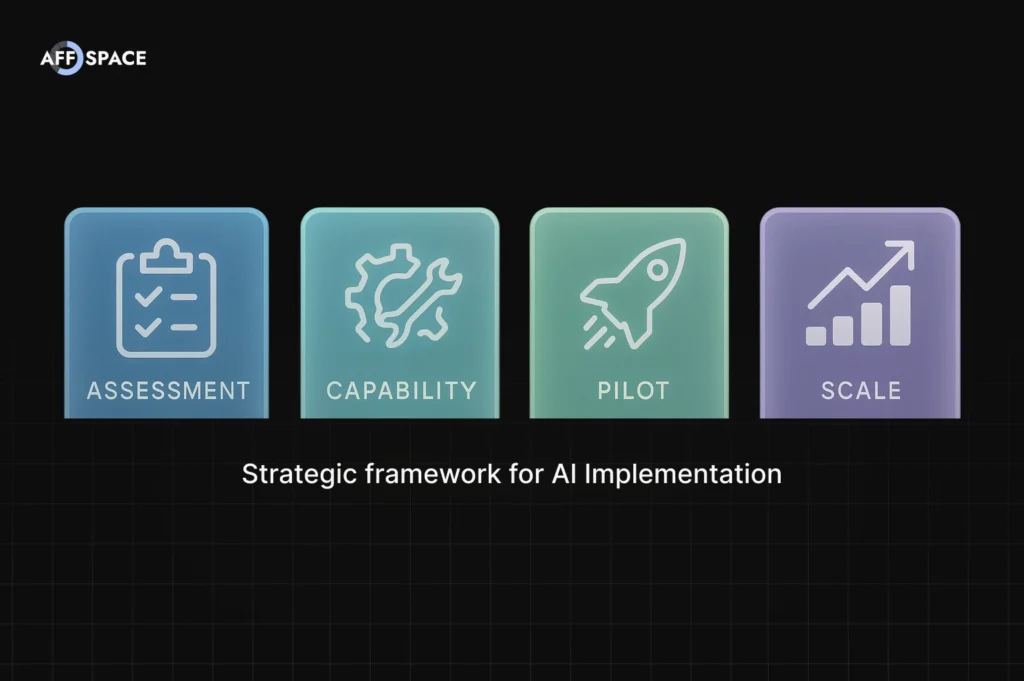
Whether you manage a solo affiliate site or oversee multiple partner programs, AI integration follows four core phases: Assessment → Capability → Pilot → Scale.
This framework ensures smooth adoption and long-term ROI.
Phase 1: Assessment — Understanding Needs and Opportunities
The first step in using affiliate marketing AI tools effectively is an honest evaluation of your current operations. Identify where you’re spending the most manual time, where errors frequently occur, and where automation can produce measurable benefits.
Ask these questions before you invest in any AI affiliate marketing tools:
- Which daily tasks consume the most time — reporting, keyword research, content creation, or campaign analysis?
- Do I already have reliable data sources that AI can learn from (Google Analytics, CRM, affiliate dashboards)?
- What performance goals can AI realistically help me achieve — higher CTRs, better ROI, or faster scaling?
During assessment, map out your data flow — where information enters, how it’s stored, and which metrics matter most.
AI systems thrive on high-quality data. If your tracking is incomplete or inconsistent, start by improving data hygiene before layering advanced automation.
This stage often reveals that many teams under-utilize free AI tools for affiliate marketing, like Google Gemini for keyword clustering or ChatGPT for quick content ideation. Identifying small AI wins early helps build momentum for broader implementation.
Phase 2: Capability Building — Preparing People and Data
Once you’ve defined your goals, it’s time to strengthen internal capabilities. AI doesn’t replace marketers — it enhances their decision-making. The more you understand how AI works, the better you can guide it.
Core capability areas include:
- Data Readiness – Organize your affiliate performance data into structured, clean datasets that can feed your chosen AI platform.
- Team Training – Educate your staff on interpreting AI insights and spotting anomalies.
- Tool Selection – Identify the best AI tools for affiliate marketing for each task:
- SEO & Content: Surfer SEO, Jasper, ChatGPT
- Analytics: AnyTrack, Voluum, Triple Whale
- Ad Optimization: Revealbot, Madgicx, Optmyzr
- Design & Video: Canva Magic Studio, Pictory, Runway ML
- SEO & Content: Surfer SEO, Jasper, ChatGPT
If you’re just starting, use free AI tools for affiliate marketing to test workflows before investing in premium platforms. For instance, automate A/B test ideas using ChatGPT prompts or experiment with keyword clustering in Google Sheets enhanced by AI plugins.
This capability-building phase ensures your team can interpret outputs intelligently rather than following AI blindly — the difference between insight and automation dependency.
Phase 3: Pilot — Testing AI on High-Impact Tasks
Once your team and data are ready, begin with a pilot program — a controlled environment for experimentation. Choose one high-impact area that offers measurable metrics, such as content performance, ad optimization, or lead scoring.
Example pilot objectives might include:
- Reducing content production time by 30% with AI writing assistants
- Improving ad ROI by 25% through automated targeting tools
- Increasing email click-through rates using AI-driven personalization
Start small: test a few affiliate marketing AI tools within that workflow, monitor results, and document insights.
Key metrics to track:
- Time saved compared to manual execution
- Cost reduction and conversion improvement
- Quality consistency across campaigns
The pilot phase helps validate assumptions and reveal how AI interacts with your data ecosystem. You’ll quickly see which models integrate seamlessly — and which overcomplicate operations.
Popular pilot setups often include tools like Jasper + Surfer SEO for content optimization or Optmyzr + Google Ads AI for predictive bidding. These pairings demonstrate how human creativity and machine precision work hand-in-hand.
Phase 4: Scale — Automate, Optimize, and Monitor
After the pilot demonstrates success, scale strategically. Expansion doesn’t mean automating everything at once; it means extending proven AI applications while refining processes.
Scaling involves:
- Standardization – Create documented processes for each AI-driven workflow, ensuring consistency as you grow.
- Automation Layering – Use tools like Zapier or Make to connect AI platforms across systems — linking analytics dashboards, CRM data, and affiliate reporting.
- Continuous Training – Retrain models regularly with updated data. AI performance declines if left static.
- Performance Governance – Assign KPIs to each AI process: cost per acquisition, conversion uplift, time saved, etc.
As your operations mature, integrate higher-end systems like TensorFlow or custom ML models for unique use cases (fraud detection, predictive commissions, partner scoring).
At this point, you’ll transition from using AI tools for affiliate marketing as helpers to AI-driven systems managing data, optimizing campaigns, and surfacing insights automatically.
Scaling Without Losing Control
It’s tempting to over-automate once early AI success appears. The best affiliate marketers balance machine intelligence with human creativity.
AI is powerful for data analysis and prediction, but brand voice, storytelling, and trust still depend on human experience.
Build oversight loops — review AI-generated content before publishing, validate automated campaign changes, and continually refine algorithms with your expertise.
When executed properly, this hybrid approach produces results impossible through either humans or machines alone.
Advanced AI Applications Transforming Affiliate Marketing Performance
Once the foundational AI systems are in place, affiliate marketers can unlock exponential growth by applying advanced AI tools for affiliate marketing across every stage of the funnel — from traffic generation to partner management. These cutting-edge applications turn ordinary campaigns into self-learning, continuously optimizing ecosystems.
Below are four major categories where affiliate marketing AI tools are reshaping performance, transparency, and profitability.

1. Dynamic Pricing and Commission Optimization
AI-powered dynamic pricing is changing how both affiliate networks and marketers approach monetization. In traditional models, affiliates rely on fixed commissions or standard rates. AI disrupts this by analyzing real-time factors — market demand, competitor pricing, conversion probability — and automatically adjusting offers or bids for maximum profitability.
Key benefits:
- Real-Time Adjustments: AI algorithms monitor competitor activity and update commission structures or ad bids instantly.
- Predictive Performance: Machine learning models forecast when conversion likelihood is highest, ensuring budget allocation where ROI peaks.
- Smarter Promotions: Using historical data, AI tools recommend when to push seasonal products, offer discounts, or test alternate pricing tiers.
Platforms like Admitad AI Suite and Everflow Smart Bidding leverage predictive analytics to fine-tune offers dynamically. This creates a competitive advantage for affiliates running multiple verticals — from SaaS to eCommerce — where small pricing optimizations can lead to significant performance boosts.
In the future, expect dynamic AI pricing to become a standard component of the best AI tools for affiliate marketing, blending market intelligence with personalized incentives to maximize conversions.
2. Fraud Detection and Quality Assurance
Affiliate marketing’s growth also attracts fraud — fake clicks, cookie stuffing, or bot-generated conversions. Manual review can’t keep up with this scale. Enter AI affiliate marketing tools powered by anomaly detection and predictive modeling.
AI-driven fraud detection systems continuously monitor transactions, traffic sources, and conversion behaviors to identify suspicious anomalies in real time.
Machine learning models flag irregularities, such as:
- Unusual click-to-conversion ratios
- Repeated actions from the same IP address
- Traffic spikes from new geographies or unverified partners
These automated defenses save affiliate managers time and money while preserving network integrity.
Examples of AI tools for affiliate marketing fraud detection:
- TrafficGuard – Uses ML-based threat detection to filter invalid clicks.
- Forensiq – Analyzes impression data for fraud patterns.
- CHEQ Essentials – Detects non-human traffic and filters bots before they impact budgets.
By combining automation with advanced data analytics, marketers not only prevent fraud but also gain visibility into true partner performance. This level of transparency builds trust — a critical element in maintaining strong affiliate relationships.
3. Competitive Intelligence and Market Analysis
Data is the lifeblood of competitive advantage, and AI has revolutionized how affiliates collect and interpret it. The best AI tools for affiliate marketing provide comprehensive competitor tracking and trend analysis that once required entire research teams.
AI-powered competitive intelligence tools aggregate millions of data points from across the web to deliver insights such as:
- Which products or niches are trending globally
- What types of content formats and creatives convert best
- How competitors structure their landing pages or ad funnels
For instance, tools like Similarweb AI, SpyFu, and Semrush’s Market Explorer use machine learning and NLP to reveal emerging keyword trends, ad copy angles, and backlink opportunities.
These platforms also highlight where competitors underperform — helping affiliates position themselves strategically in content gaps or under-served markets.
In practical terms, this means you can discover high-potential sub-niches faster and build data-backed content before others catch on.
AI-driven insights also help affiliates choose the right programs and products to promote, increasing both commissions and authority. By pairing competitive analysis with affiliate marketing AI tools, marketers make informed decisions instead of guessing based on surface-level trends.
4. Automated A/B Testing and Multivariate Optimization
Traditional A/B testing limits marketers to comparing one or two variations at a time. AI multiplies that power through continuous, multivariate testing — analyzing countless combinations of headlines, CTAs, layouts, and visuals simultaneously.
AI testing platforms such as Optimizely AI, VWO SmartStats, and Google Optimize 360 leverage machine learning to:
- Generate and test multiple page or ad variations automatically
- Analyze user behavior in real-time
- Shift traffic toward top-performing combinations dynamically
This enables affiliates to optimize for conversion at a level of precision impossible through manual testing.
Over time, these AI models learn from thousands of micro-interactions — identifying what resonates best with each user segment and refining campaigns continuously.
For affiliates running paid ads or landing pages across multiple verticals, AI A/B testing can reduce campaign waste by as much as 40%, freeing resources for scaling.
The best AI tools for affiliate marketing integrate this automation natively, turning experimentation into a perpetual optimization loop.
Instead of scheduling weekly tests, the system adapts automatically — refining creatives, layout, and messaging on the fly.
Advanced AI Beyond the Basics
As these systems evolve, additional innovations are entering the market:
- Predictive lead scoring – AI estimates which prospects are most likely to convert before engagement.
- Voice search optimization – NLP helps adapt affiliate content for voice-based queries.
- Visual product matching – Computer vision recognizes and auto-tags products in photos or videos for eCommerce affiliates.
Combined, these innovations represent a leap forward in operational intelligence. They transform affiliate marketing from a reactive discipline into a predictive, self-improving system.
Case in Point: Combining Free and Premium AI Tools
Many affiliates mistakenly assume they need high-end paid platforms to harness AI. In reality, mixing free AI tools for affiliate marketing with premium analytics can deliver exceptional results.
Example workflow:
- Data Gathering: Use Google Trends, ChatGPT, or Glasp AI to research topic clusters and content gaps.
- Content Optimization: Apply Surfer SEO’s NLP assistant for on-page recommendations.
- Automation Layer: Deploy Zapier AI actions to send campaign data from Google Sheets to your analytics dashboard.
- Performance Review: Analyze conversions using AnyTrack + GA4 AI Insights to identify your top-performing partners.
This hybrid approach — combining accessible tools with enterprise analytics — maximizes efficiency and scales gracefully as your business grows.
Even beginner affiliates can start integrating AI today without significant investment. Free options for writing, image creation, and keyword analysis are widely available, offering a zero-cost entry point into the world of AI affiliate marketing tools.
Ethical AI, Data Infrastructure, and Future-Proofing Strategies
Implementing AI tools for affiliate marketing goes far beyond automation or analytics — it requires thoughtful data management, responsible deployment, and an adaptive mindset. The most successful affiliate businesses in 2025 will be those that treat AI not as a shortcut, but as a long-term strategic partner grounded in ethics and continuous learning.
Building a Reliable Data Infrastructure for AI-Driven Affiliate Marketing
All great AI systems start with clean, consistent, and comprehensive data. Without it, even the best AI tools for affiliate marketing will deliver misleading or incomplete insights.
1. Data Collection and Integration
Create a single source of truth by connecting all your data points — traffic analytics, CRM inputs, affiliate dashboards, and social insights — into one hub. Tools like AnyTrack, Supermetrics, or Funnel.io automate this aggregation, ensuring every campaign touchpoint becomes usable data.
2. Data Cleaning and Structuring
AI models depend on accuracy. Remove duplicate conversions, tag UTM parameters consistently, and validate event tracking. A unified taxonomy enables your affiliate marketing AI tools to interpret behavior patterns correctly.
3. Cloud-Based Storage and APIs
Modern affiliate programs increasingly rely on APIs for data exchange. Using systems such as BigQuery or Snowflake allows scalable, real-time connections with AI dashboards and automation scripts.
4. Accessibility and Governance
Establish permission rules and documentation. When everyone knows where data lives and how it’s used, AI adoption becomes faster and safer.
By investing early in solid data architecture, you unlock the full predictive potential of AI affiliate marketing tools — from advanced forecasting to automated partner performance scoring.
Ethical and Transparent AI in Affiliate Programs
AI adds power, but also responsibility. Affiliates handle consumer data, personalized recommendations, and promotional automation — all of which demand transparency.
1. Clear Disclosures
Just as marketers must reveal affiliate links, they should also disclose AI-assisted content generation where relevant. Transparency builds credibility and prevents regulatory issues.
2. Bias Detection
Algorithms trained on biased data can misinterpret audience segments or unfairly prioritize certain offers. Regularly audit AI outputs across demographics and geographies to maintain balance and fairness.
3. Privacy Protection
Adopt privacy-first principles. Collect only essential data, anonymize user identifiers, and follow frameworks like GDPR, CCPA, or regional equivalents. Tools with built-in differential privacy — such as Google AI’s Privacy Sandbox — enable performance tracking without invasive profiling. Follow GDPR-compliant practices and minimize unnecessary data storage. Employ privacy-preserving AI techniques like federated learning when possible. Review ethical AI frameworks such as OECD’s Principles and IBM’s standards to maintain compliance globally.
4. Compliance Automation
Several affiliate marketing AI tools now include compliance monitoring modules that flag undisclosed affiliate links or detect potentially misleading claims automatically. Examples include Affise Protect and Impact’s Brand Safety AI.
Being proactive about ethical AI not only mitigates legal risk — it enhances user trust, which directly improves long-term conversions and partner relationships.
Responsible Use of AI Content Generation
With the surge of free AI tools for affiliate marketing, producing content has never been easier — but quality still wins over quantity. To balance efficiency with authenticity:
- Use AI for outlines, structure, and data synthesis — but add your human expertise and storytelling flair.
- Run AI-generated drafts through plagiarism and factual-accuracy checks.
- Combine NLP-based optimization (e.g., SurferSEO, Frase, or Jasper) with manual editing to maintain unique brand tone.
The most sustainable approach is a human-in-the-loop workflow — letting AI handle research and repetition while you focus on insight, emotion, and strategy.
Measuring Success: KPIs for AI Implementation
To confirm ROI, define metrics before deploying any AI affiliate marketing tools.
| Category | Example Metrics | What It Proves |
| Efficiency | Time saved on reporting or content creation | Automation effectiveness |
| Performance | Conversion rate, CTR, EPC, ROI | Revenue growth |
| Quality | Bounce rate, engagement depth | User experience improvement |
| Scalability | Number of campaigns managed per user | AI leverage capacity |
Combine quantitative data (revenue lift, time saved) with qualitative insights (team adoption, partner satisfaction) for a complete performance picture.
Future-Proofing Your AI-Driven Affiliate Strategy
AI evolves rapidly — but you can future-proof your business by building adaptive systems rather than static workflows.
1. Stay Current with Innovation
Subscribe to AI and martech newsletters, follow affiliate conferences (PI LIVE, Affiliate World), and monitor releases from OpenAI, Google, and Meta. Early awareness gives you first-mover advantage.
2. Build Modular Workflows
Use flexible tools that integrate through APIs or no-code automation (Zapier, Make, or n8n). Modular systems can swap components easily as new AI tools for affiliate marketing emerge.
3. Diversify Channels
Don’t depend on one traffic source or platform algorithm. Combine SEO, paid media, email, and influencer collaborations — all optimized through AI insights — to ensure resilience.
4. Continue Learning and Experimenting
AI’s competitive edge compounds over time. Schedule quarterly experiments: test new recommendation models, explore voice-search optimization, or pilot AI video generation for product reviews. Document every insight to accelerate learning loops.
The Human Element: AI as Your Collaborative Partner
AI won’t replace affiliate marketers — but affiliates who learn to use AI will outperform those who don’t.
Machines excel at speed, pattern recognition, and scale. Humans bring creativity, empathy, and ethical judgment.
Together, they form the foundation of a professional, future-ready affiliate marketing career powered by technology yet guided by human intelligence.
When selecting the best AI tools for affiliate marketing, remember that the goal isn’t simply automation — it’s amplification: multiplying your insight, productivity, and precision to achieve outcomes previously unreachable without full-time teams.
Conclusion: Shaping the Future of Affiliate Marketing with AI
Artificial intelligence has moved from optional enhancement to core necessity. In the next few years, affiliates who embrace AI strategically — combining automation, ethics, and data fluency — will dominate their niches.
From free entry-level systems to enterprise analytics suites, AI tools for affiliate marketing now empower creators, publishers, and program managers alike to predict outcomes, personalize experiences, and scale profitably.
The winning formula is simple:
Data + Strategy + Ethical AI = Sustainable Growth.
By applying the frameworks, technologies, and best practices outlined here, you can turn your affiliate operation into a modern, intelligent business — one capable of evolving as fast as the algorithms shaping the digital world.
FAQ: Common Questions About AI in Affiliate Marketing
1. What are the best AI tools for affiliate marketing in 2025?
Top performers include Surfer SEO, Jasper, AnyTrack, Voluum, ChatGPT, and Pictory. They cover everything from content intelligence and analytics to ad automation.
2. Are there free AI tools for affiliate marketing beginners?
Yes — ChatGPT, Google Gemini, Canva Magic Write, and Writesonic Free Plan offer robust entry-level features ideal for small teams testing AI workflows.
3. How can AI improve affiliate marketing ROI?
By automating optimization, predicting conversions, and personalizing recommendations, AI reduces waste and boosts profit margins across every campaign.
4. Is it ethical to use AI-generated content for affiliate blogs?
Absolutely — as long as it’s fact-checked, edited, and transparently disclosed. Follow FTC rules and prioritize value for your readers.
5. What’s the future of AI in affiliate marketing?
Expect deeper integration with predictive analytics, automated partner recruitment, and real-time personalization — all supported by scalable, privacy-compliant AI ecosystems.
