

Amazon Associates in 2026: Honest Review + What High-Earning Affiliates Do Instead
The Amazon Affiliate Program, officially known as Amazon Associates, represents one of the most accessible entry points into affiliate marketing. With millions of products available for promotion and one of the world’s most trusted brand names behind it, understanding how the Amazon affiliate program works can be your gateway to earning commissions online—whether you’re a blogger, content creator, or digital marketer looking to monetize your platform.
This comprehensive guide examines every aspect of the Amazon affiliate program, from sign-up requirements and commission structures to proven strategies for maximizing your earnings. You’ll learn whether Amazon affiliate marketing is right for you, how to navigate the program’s requirements, and actionable tactics used by successful affiliates earning consistent income through affiliate marketing.
What Is the Amazon Affiliate Program?
The Amazon affiliate program, branded as Amazon Associates, is a performance-based marketing program allowing website owners, bloggers, content creators, and social media influencers to earn commissions by promoting Amazon products. When visitors click your unique affiliate links and make purchases on Amazon, you receive a percentage of the sale as commission.
How the Amazon Affiliate Program Works
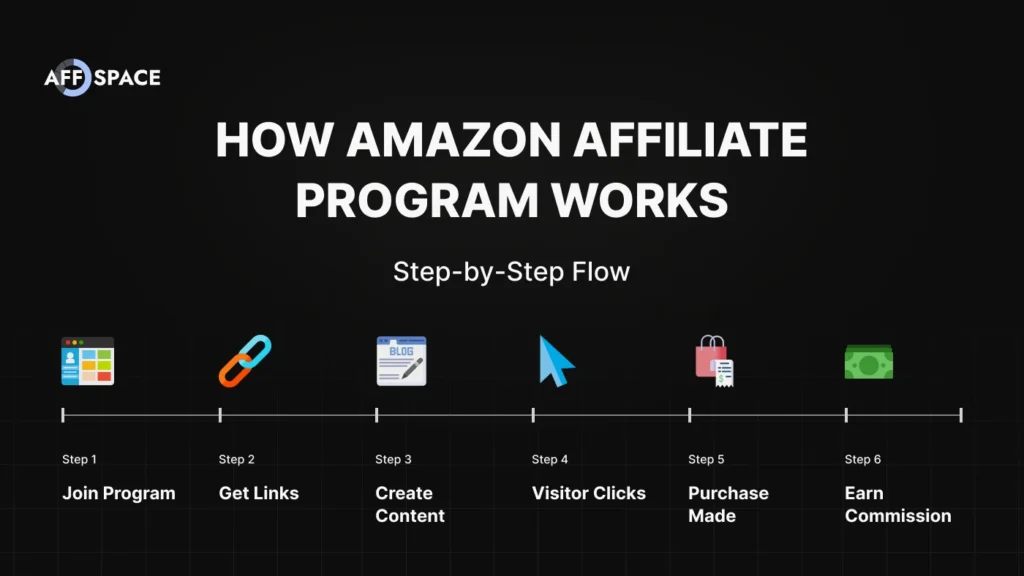
Understanding how affiliate marketing works through Amazon follows a straightforward process. After joining Amazon Associates, you receive access to unique tracking links for any product sold on Amazon. You integrate these links into your content—whether blog posts, YouTube videos, social media posts, or email newsletters. When someone clicks your link and purchases that product (or anything else) within the cookie window, you earn a commission.
The Amazon affiliate program operates on a 24-hour cookie duration for most purchases, meaning customers must complete their purchase within 24 hours of clicking your link for you to receive credit. However, if items are added to cart within 24 hours and purchased within 90 days, you still earn commission—making cart additions particularly valuable.
⚠️ Cookie Window Reality Check
The affiliate industry standard cookie window for performance-based programs ranges from 30 to 180 days. Amazon’s 24-hour window is one of the shortest in affiliate marketing — meaning any visitor who clicks your link but purchases 2 days later earns you nothing.
Why Choose Amazon Affiliate Marketing?
Several compelling reasons make the Amazon affiliate program attractive despite relatively modest commission rates compared to other programs:
Brand Trust: Amazon’s unparalleled brand recognition removes much of the trust barrier in online purchases. Customers already shop on Amazon regularly, making conversions easier than promoting unknown brands.
Product Diversity: With millions of products across virtually every imaginable category, you can find relevant items for any niche. This versatility means one affiliate account serves multiple content themes.
Reliable Tracking: Amazon’s tracking technology is robust and established, ensuring you receive proper credit for qualified purchases. The system handles cookies, attribution, and reporting transparently.
Global Reach: Amazon operates in numerous countries, allowing you to promote products to international audiences through various regional affiliate programs.
Established Infrastructure: Payment processing is reliable, customer service handles buyer issues, and the entire fulfillment process is managed by Amazon—you focus purely on marketing.
Amazon Affiliate Program Sign Up: Getting Started
Joining the Amazon affiliate program is relatively straightforward, but understanding requirements and best practices ensures smooth approval and compliance.
Amazon Affiliate Program Requirements
Before applying, ensure you meet Amazon’s basic requirements for the Amazon affiliate program:
Active Website or Mobile App: You need a functioning website, blog, app, or established social media presence. The platform must contain original content—not just affiliate links or replicated material from other sources.
Content Standards: Your site must provide genuine value with original, quality content relevant to products you’ll promote. Amazon reviews applications to ensure affiliates maintain appropriate content standards.
Public Accessibility: Content must be publicly accessible for Amazon to review during the application process. Private or password-protected sites typically don’t qualify until they’re publicly viewable.
Traffic Generation Capability: While Amazon doesn’t specify minimum traffic requirements upfront, you’ll need to generate at least three qualified sales within 180 days of approval to maintain active status.
Compliance with Policies: Familiarity with Amazon’s Operating Agreement is essential. The agreement outlines prohibited practices, disclosure requirements, and proper link usage.
How to Sign Up for Amazon Affiliate Program: Step-by-Step Process
Let’s walk through exactly how to do Amazon affiliate marketing by joining the program:
Step 1: Visit Amazon Associates Homepage
Navigate to affiliate-program.amazon.com (or your regional Amazon Associates site). Click “Sign Up” to begin the application process.
Step 2: Sign In or Create Amazon Account
Use your existing Amazon customer account or create a new one specifically for your affiliate activities. Many affiliates prefer separate accounts to keep personal shopping distinct from business tracking.
Step 3: Provide Account Information
Enter your legal name, address, and phone number. This information must be accurate as it’s used for tax reporting and payment processing.
Step 4: Add Website and Mobile App Information
List all websites, apps, and platforms where you’ll promote Amazon products. For each, provide:
- Full URL (including http:// or https://)
- Brief description of content and audience
- Topic categories that best describe your niche
For social media profiles like YouTube, Instagram, or TikTok, include profile URLs and follower counts.
Step 5: Describe Your Websites and Traffic
Amazon asks several questions about your platform:
- What topics does your site cover?
- How do you drive traffic? (SEO, social media, paid ads, email, etc.)
- How do you build links? (Will you create product reviews, comparison articles, resource pages?)
- Monthly visitor estimates
Answer honestly—these responses help Amazon understand your promotional strategy but don’t automatically disqualify based on traffic levels.
Step 6: Select Preferred Store ID
Choose a tracking ID (Store ID) for your account. This identifier appears in your tracking links and helps you organize campaigns if you later create multiple tracking IDs for different sites or strategies.
Step 7: Confirm Identity
Enter a phone number for identity verification. Amazon will either call or text a verification code that you must enter to proceed.
Step 8: Enter Payment and Tax Information
Provide payment details and complete tax information:
- Payment method: Direct deposit, Amazon gift card, or check (minimums apply)
- Tax information: W-9 (US citizens) or W-8BEN (international) for IRS reporting
Step 9: Review and Submit Application
Review all information carefully before submitting. Once submitted, Amazon reviews your application—usually approving within 24-48 hours if requirements are met.
Post-Approval: 180-Day Qualification Period
Approval is initially conditional. You must generate at least three qualified sales within 180 days to maintain active status. If you don’t meet this threshold, your account is suspended and must reapply. This requirement ensures affiliates actively promote products rather than simply holding dormant accounts.
Amazon Affiliate Commission Rates and Payment Structure
Understanding commission rates is crucial for realistic income expectations in Amazon affiliate marketing.
Amazon Affiliate Commission by Category
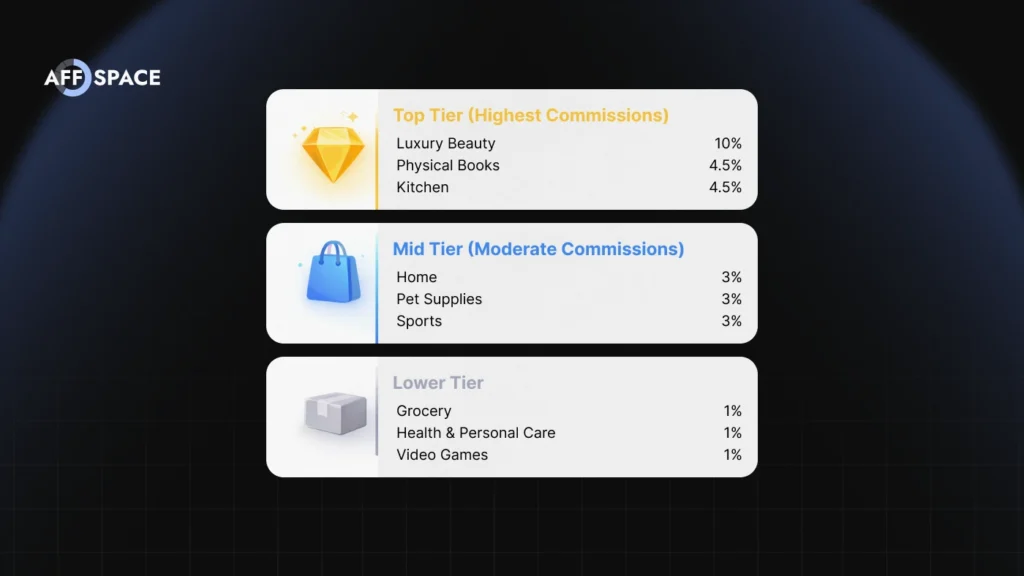
Amazon has reduced commission rates multiple times since 2017. The April 2020 cut reduced most categories by 2–3 percentage points. Rates have remained largely flat since — but there is no guarantee they won’t be cut again.
Important
The average effective commission across all Amazon affiliate accounts is approximately 2.5–3.5% in 2026. Most affiliates earn far less than the advertised 10% headline rate because high-commission categories (luxury beauty, books) represent a small share of overall traffic.
Amazon uses a category-based commission structure where rates vary significantly depending on what customers purchase:
Luxury Beauty, Amazon Coins: 10%
Physical Books, Kitchen, Automotive: 4.5%
Digital Music, Physical Music, Handmade: 5%
Outdoor, Tools, Lawn & Garden: 4.5%
Home, Sports, Pet Supplies, Baby Products: 3%
Digital Videos, Physical Video Games: 4%
PC, Home Improvement: 2.5%
Amazon Fresh, Physical Video Games: 1%
Grocery, Health & Personal Care: 1%
Video Games and Consoles: 1%
Amazon Gift Cards, Alcohol, Digital Products via Kindle Unlimited: 0% (special programs or no commission)
These rates change periodically—Amazon has reduced rates several times historically, most notably in April 2020 when many categories saw significant decreases.
How Amazon Affiliate Commission Works
Commission calculations follow specific rules:
Shopping Cart Commissions: You earn commission on items customers add to cart within 24 hours of clicking your link and purchase within 90 days. This includes items beyond what you specifically promoted—if someone clicks your link for a book but also purchases electronics and home goods in that session, you earn commissions on all qualifying items.
Commission Cap: Amazon applies a maximum commission limit per item. For example, even at a 10% rate, if an individual item exceeds the cap ($1,000 on luxury beauty), your commission is capped at $100 per unit.
Excludes Certain Items: You don’t earn commissions on:
- Amazon Prime memberships
- Subscribe & Save subscriptions
- Amazon Fresh (unless specific program)
- Certain digital subscriptions
- Purchases the associate makes through their own links
Payment Schedule and Methods
Amazon pays affiliates approximately 60 days after month-end once minimum thresholds are met:
Direct Deposit: $10 minimum (US), varying minimums internationally Amazon Gift Card: $10 minimum Check: $100 minimum (US)
For example, commissions earned in January are paid at the end of March. This delay accounts for return processing and ensures Amazon doesn’t pay on orders that are subsequently refunded.
Is Amazon Affiliate Marketing Legit and Profitable?
A common question from beginners: is Amazon affiliate marketing legit? Absolutely—Amazon Associates is a legitimate program operated by one of the world’s largest companies. Millions of content creators, bloggers, and marketers participate in the Amazon affiliate program, generating billions in referred sales annually.
However, “legit” doesn’t automatically mean “easily profitable.” Success requires realistic expectations about earnings potential. With commission rates of 1-10% and typically averaging 3-4% across categories most affiliates promote, you need significant traffic and high conversion rates to generate meaningful income.
For perspective: If your average commission is 4% and average order value is $50 (earning you $2 per conversion), and your conversion rate is 3%, you need approximately 17,000 monthly visitors to earn $1,000/month. This math isn’t discouraging—it’s realistic. Many successful affiliates generate full-time income through Amazon, but it requires building substantial, targeted traffic and optimizing conversion strategies.
Amazon Affiliate Marketing for Beginners: Essential Strategies
Starting with the Amazon affiliate program as a beginner requires understanding both platform requirements and effective promotional tactics. For broader context on getting started, see our guide on how to become an affiliate marketer.
Choose Your Niche Strategically
While Amazon’s product diversity is advantageous, successful Amazon affiliate marketing for beginners starts with niche focus. Don’t try promoting everything—select specific product categories aligned with your content expertise and audience interests.
Consider Commission Rates: Some niches offer better rates. Tech accessories (2.5%), books (4.5%), and kitchen products (4.5%) balance reasonable commissions with strong conversion potential. Understanding the best niches for affiliate marketing helps you choose strategically.
Evaluate Competition: Highly competitive niches (electronics, weight loss) require more resources to rank and convert. Consider underserved sub-niches where you can establish authority more quickly.
Assess Personal Interest: You’ll create substantial content in your niche. Genuine interest and knowledge help produce authentic, valuable content that builds trust and converts better than purely profit-motivated promotions.
Create High-Quality, SEO-Optimized Content
Content quality directly impacts Amazon affiliate marketing success. Focus on creating comprehensive resources that help audiences make informed purchasing decisions.
Product Reviews: Detailed reviews showcasing product features, benefits, drawbacks, use cases, and comparisons provide immense value. Include personal experience when possible—authenticity builds trust that drives conversions.
Comparison Articles: “Product A vs. Product B” content ranks well for commercial intent keywords and helps buyers decide between options. Include detailed comparison tables, photos, and clear recommendations for different buyer needs.
Buying Guides: Comprehensive guides educating readers about product categories, key features to consider, budget ranges, and top recommendations serve early-stage researchers and rank for high-volume informational keywords.
Best-Of Lists: “Best [Product] for [Purpose]” articles aggregate multiple products, allowing promotion of several items in one comprehensive piece. These rank well and serve various buyer preferences and budgets.
Implement solid SEO foundations to drive organic traffic—the most sustainable, scalable source for Amazon affiliates. Learn more about SEO strategies for affiliate marketing.
Optimize Affiliate Link Placement
Strategic link placement significantly impacts click-through and conversion rates:
Contextual Links: Place links naturally within content where readers expect them—when mentioning specific products, discussing features, or making recommendations.
Comparison Tables: Product comparison tables with “Check Price” buttons convert exceptionally well for readers actively comparing options.
Image Links: Product images with affiliate links often outperform text links, particularly for visually-driven categories like fashion, home decor, or electronics.
Resource Boxes: Highlighted boxes summarizing product details with prominent call-to-action buttons stand out and drive clicks.
Multiple Strategic Placements: Include links early (capture engaged readers), mid-content (contextual recommendations), and in conclusion (final call-to-action). Don’t overdo it—aim for helpful rather than spammy.
Disclose Your Affiliate Relationship
FTC regulations require clear disclosure of affiliate relationships. Amazon’s Operating Agreement mandates disclosure on any page containing affiliate links.
Place clear disclosures near affiliate links stating something like: “As an Amazon Associate, I earn from qualifying purchases” or “This post contains affiliate links, meaning I earn commissions on purchases made through these links at no additional cost to you.”
Disclosure builds trust rather than deterring purchases—audiences appreciate transparency and understand content creators earn through recommendations.
Diversify Beyond Amazon
While focusing on the Amazon affiliate program makes sense initially, don’t limit yourself exclusively to Amazon. The relatively low commission rates and 24-hour cookie window limit earning potential compared to direct-to-consumer programs or other affiliate networks.
Explore complementary programs offering higher commissions or longer cookie windows. For example, if promoting tech products, many manufacturers offer direct affiliate programs with 5-10% commissions and 30-90 day cookies. Learn about choosing the best affiliate programs to join to diversify strategically.
Advanced Amazon Affiliate Marketing Tactics
Once you’ve mastered Amazon affiliate marketing basics, implement these advanced strategies to scale earnings.
Leverage Amazon Native Shopping Ads
Amazon provides native advertising units displaying dynamically-selected products relevant to your content and audience. These ads automatically show products visitors are likely to purchase based on Amazon’s algorithms, often converting better than manually-selected product links.
Native Shopping Ads include:
- Recommendation Ads: Display products related to your content
- Search Ads: Show search results for keywords you specify
- Custom Ads: Feature specific products you select
These units require less ongoing management than individual product links and benefit from Amazon’s recommendation engine.
Build Email Lists for Ongoing Promotion
Email marketing provides direct access to engaged audiences, allowing repeated product promotion without depending solely on organic traffic. Build lists offering valuable lead magnets (guides, checklists, tools) related to your niche.
Segment subscribers based on interests and behaviors, then send targeted recommendations aligning with their needs. Email conversion rates often exceed website conversion rates since subscribers have demonstrated interest by opting in.
Create Seasonal and Trending Content
Capitalize on seasonal shopping patterns and trending products for traffic spikes and increased conversions:
- Holiday gift guides (Black Friday, Christmas, Mother’s Day)
- Back-to-school recommendations
- New Year resolution products (fitness equipment, planning tools)
- Trending items gaining sudden popularity
Plan seasonal content months ahead, building authority before peak shopping periods when competition intensifies.
Use Amazon OneLink for International Earnings
Amazon OneLink automatically redirects international visitors to their regional Amazon store, allowing commissions on global traffic without managing multiple affiliate accounts. This increases earnings from international visitors who would otherwise not convert through US-only links.
Analyze and Double Down on Winners
Regular analytics review identifies highest-performing content and products. Use Amazon Associates reporting and Google Analytics to identify:
- Highest-earning articles
- Best-converting products
- Traffic sources driving most commissions
- Seasonal patterns affecting sales
Create more content around successful topics, update top performers with fresh information, and focus promotional efforts on proven winners rather than spreading resources equally across all content.
For comprehensive analytics strategies, explore our guide on affiliate marketing analytics and tracking.
Common Amazon Affiliate Program Mistakes to Avoid
Understanding frequent pitfalls helps you navigate the Amazon affiliate program more successfully.
Violating Program Terms
Amazon’s Operating Agreement contains numerous rules affiliates must follow. Common violations leading to account termination include:
Prohibited Traffic Methods: You cannot use AdWords to bid on Amazon-related keywords, purchase traffic from certain sources, use link shorteners in paid advertising, or engage in incentivized clicks.
Improper Link Usage: Links cannot be used in emails unless recipient requested them, embedded in ebooks or PDFs without Amazon permission, or included in offline advertising without approval.
Inadequate Disclosure: Missing or unclear disclosure of affiliate relationships violates both FTC requirements and Amazon policies.
Price/Availability Claims: You cannot include pricing or availability information in permanent content since these change frequently. Use Amazon’s tools displaying current prices dynamically.
Familiarize yourself thoroughly with the Amazon Associates Operating Agreement to ensure compliance.
Depending Solely on Amazon
Relying exclusively on the Amazon affiliate program limits earning potential. The combination of low commission rates (especially after historical reductions) and short cookie duration caps income compared to diversified strategies.
Successful affiliates use Amazon as one component in broader monetization strategies including:
- Higher-commission direct affiliate programs
- Digital product sales
- Sponsored content
- Display advertising
- Services or consulting
Neglecting Mobile Optimization
Over 60% of Amazon purchases occur on mobile devices. If your site provides poor mobile experience—slow loading, difficult navigation, unreadable text, or inaccessible links—you lose the majority of potential conversions.
Ensure your platform is mobile-responsive, loads quickly (under 3 seconds), and provides seamless mobile experience from content consumption through link clicking.
Creating Thin, Low-Value Content
Product pages with minimal original content beyond specifications and links rarely rank well or convert effectively. Invest in comprehensive, genuinely helpful content demonstrating expertise and providing value beyond simple product listings.
Detailed reviews, personal experiences, comparison analyses, use-case scenarios, and authentic recommendations significantly outperform thin affiliate pages.
Ignoring Analytics and Data
Operating without regular performance analysis wastes effort on underperforming content and strategies. Implement tracking revealing:
- Which content generates commissions
- What traffic sources convert best
- How visitors interact with your links
- When conversion rates drop (indicating needed updates)
Data-driven optimization multiplies earnings far beyond guess-and-check approaches.
Amazon Affiliate Program Alternatives and Comparisons
While Amazon Associates offers numerous advantages, understanding alternatives helps you make informed program selections and avoid over-dependence on single platforms.
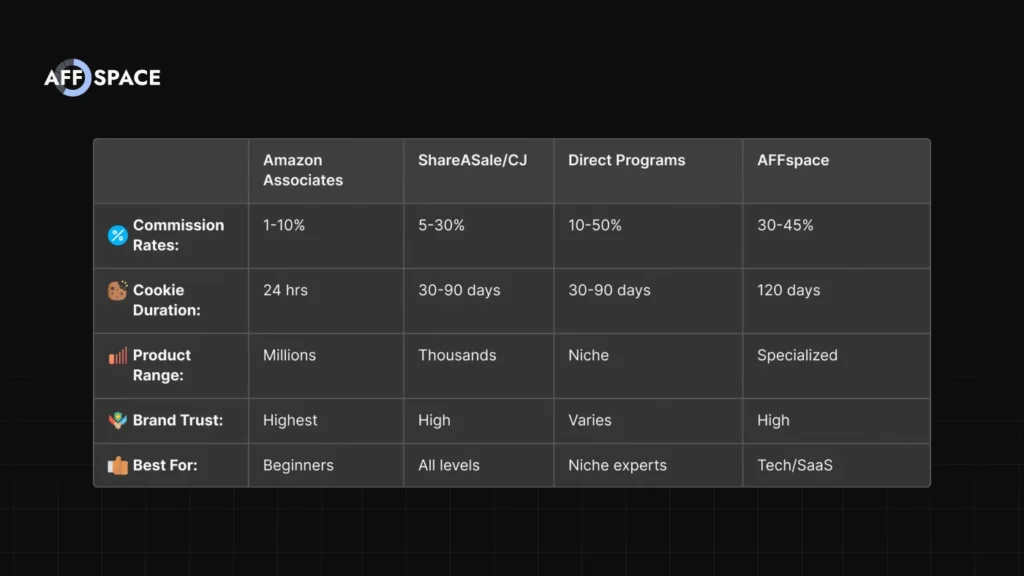
Why Consider Alternatives to Amazon Affiliate Program?
Several factors make alternative programs appealing:
Higher Commission Rates: Direct merchant programs and other networks typically offer 10-50% commissions versus Amazon’s 1-10%, dramatically affecting earning potential per conversion.
Longer Cookie Windows: Many programs provide 30-90 day cookies versus Amazon’s 24 hours, increasing conversion attribution and earnings from the same traffic.
Recurring Commissions: SaaS and subscription-based products offer ongoing monthly commissions from single referrals—creating passive income streams Amazon rarely provides.
Niche-Specific Programs: Specialized programs in your niche often convert better and pay more than broadly promoting Amazon’s entire catalog.
Key Amazon Affiliate Program Alternatives
ShareASale: One of the largest affiliate networks connecting affiliates with thousands of merchants across categories. Typically offers 5-30% commissions with 30-90 day cookies. Best for affiliates wanting diverse merchant options with better terms than Amazon.
CJ Affiliate (Commission Junction): Premium network featuring established brands and higher commission opportunities. More selective than ShareASale but offers quality merchants and reliable tracking.
ClickBank: Specializes in digital products (courses, ebooks, software) with commission rates of 50-75%. Short sales pages and sometimes questionable product quality require careful program selection. See our ClickBank affiliate program review for detailed analysis.
Individual Merchant Programs: Many brands operate direct programs offering better terms than network versions. Tech companies, SaaS platforms, and online services frequently provide lucrative affiliate opportunities with recurring revenue potential. Learn more about developing a comprehensive affiliate marketing strategy incorporating diverse programs.
AFFspace Affiliate Network: Platforms like AFFspace offer vetted programs with competitive commissions, extended cookie durations, and specialized support—worth exploring alongside traditional options.
Amazon vs. Alternatives: When Each Works Best
Use Amazon When:
- Your audience already shops on Amazon regularly
- You promote diverse product categories needing one unified platform
- Brand trust and conversion ease outweigh commission concerns
- You’re building initial affiliate experience before advanced strategies
Choose Alternatives When:
- Your niche has specific programs offering substantially higher commissions
- You need longer cookie windows for products with extended research periods
- Recurring commission opportunities exist in your niche (SaaS, memberships)
- You want to maximize per-conversion earnings with targeted promotion
Most successful affiliates use Amazon alongside complementary programs, leveraging Amazon’s strengths while capitalizing on alternatives’ higher earning potential where appropriate.
Future of Amazon Affiliate Marketing
Understanding evolving trends helps you position for continued success in Amazon affiliate marketing.
Increasing Mobile Commerce Dominance
Mobile purchases continue growing, with Amazon reporting over 60% of sales occurring on mobile devices. Optimizing for mobile-first experiences—fast loading, easy navigation, streamlined affiliate link integration—becomes increasingly crucial.
Consider formats naturally consumed on mobile: short-form video (TikTok, Instagram Reels), mobile-optimized articles, and visual platforms (Pinterest). These channels drive mobile traffic more effectively than traditional desktop-focused strategies.
Video Content Growth
Video content consumption continues accelerating, with YouTube, TikTok, and Instagram as primary discovery channels. Amazon affiliate marketing increasingly succeeds through:
- Product unboxings and demonstrations
- Comparison videos showing products side-by-side
- Tutorial content featuring Amazon products
- Review videos with honest assessments
Video builds trust effectively through visual product showcases and personality-driven content that static text struggles to match.
Voice Search Optimization
Voice-activated devices (Alexa, Google Assistant, Siri) change product discovery patterns. Optimizing for voice search—conversational keywords, question-based content, featured snippet positioning—helps capture voice-driven traffic increasingly common in Amazon product research.
AI and Personalization
Amazon continues enhancing recommendation algorithms and personalization. Native Shopping Ads and recommendation units leverage these systems, often outperforming manual product selection by displaying items visitors specifically want based on browsing history and preferences.
Affiliates integrating dynamic Amazon units benefit from continuously-improving AI-driven product matching without manual optimization.
Commission Rate Scrutiny
Amazon has reduced commission rates multiple times historically, most significantly in 2020. While rates have stabilized recently, affiliates should maintain awareness that Amazon may adjust rates based on business needs.
This reality reinforces the importance of income diversification beyond exclusive Amazon dependence. Build audiences and platforms where you can pivot to alternative monetization if Amazon rates become unsustainable.
Amazon Associates vs High-Commission Programs: What the Numbers Actually Show
The Amazon affiliate program is the world’s most accessible affiliate program — but accessible is not the same as profitable for experienced affiliates.
Here is what the commission math looks like side by side:
| Amazon Associates | CPA + RevShare Programs | |
| Commission rate | 1–10% (avg 2.5–3.5%) | 20–75% (digital) / up to $50 CPA |
| Cookie duration | 24 hours | 30–120 days |
| Recurring commissions | No | Yes (RevShare on rebills) |
| Payment threshold | $10 | Varies ($50–$100 typical) |
| Niche flexibility | Any product | Program-specific |
For a $97 software product: Amazon pays $0 (not sold on Amazon). A CPA program pays up to $50. A RevShare program paying 45% pays $43.65 — and 25% on every rebill after that.
This is why affiliates with established traffic often promote Amazon for broad product content while using dedicated CPA or RevShare programs for their highest-intent traffic.
When Amazon Associates Is the Right Choice
Amazon works best when: your content covers a broad range of physical products, your audience is not in a specific niche that has dedicated affiliate programs, you are early in your affiliate journey and need an easy-to-join program, or you are a review site covering consumer electronics, home goods, or books where Amazon has the best product range.
When to Look for Higher-Paying Alternatives
If your content targets software, SaaS, digital products, mobile apps, or subscription services — Amazon is not the right program. These niches have dedicated affiliate programs offering commission structures Amazon fundamentally cannot match.
Specifically, consider alternatives when:
- Your niche products are not sold on Amazon
- Your audience has a long decision cycle (days or weeks, not hours)
- You want recurring income from rebill commissions
- You need a 30–120 day cookie window to capture delayed conversions
A program like AFFSpace — covering monitoring and software products — offers 45% RevShare on first sales, 25% on rebills, and a 120-day cookie. The per-conversion earnings are structurally higher than Amazon for the right niche.
The Amazon affiliate program is a legitimate, well-built program best suited to content affiliates covering broad consumer product categories. For beginners, it provides an accessible starting point. For experienced affiliates high-commission affiliate programs, with niche audiences, the commission structure and 24-hour cookie often mean leaving significant revenue on the table.
The right approach for most affiliates: use Amazon for broad content where dedicated programs do not exist, and use higher-commission programs for your highest-intent traffic. Diversifying across both maximises total earnings without abandoning Amazon’s conversion advantages. Ready to compare your options? See our guide to choosing the best affiliate program — or explore AFFspace if you operate in the software, tech, or monitoring niche.
Ready to start your Amazon affiliate marketing journey? Begin by understanding how affiliate marketing works, then apply these strategies systematically. Whether you’re completely new to affiliate marketing or experienced marketer expanding into Amazon, the opportunities await those willing to do the work. For beginners seeking comprehensive guidance, explore our affiliate marketing for beginners guide covering essential foundations beyond just Amazon. And if you’re starting with limited budget, our guide on how to start affiliate marketing with no money provides practical zero-cost strategies to launch your affiliate business.
