

Pinterest Affiliate Marketing: Complete Strategy Guide
Back in 2019, I spent three months posting affiliate links on Instagram stories, barely breaking $200 in commissions as content disappeared within 24 hours. Then I discovered Pinterest affiliate marketing. Six months later, a single pin I’d created in under an hour had generated 47,000 impressions and $840 in affiliate sales. That pin still brings in traffic today, five years later.
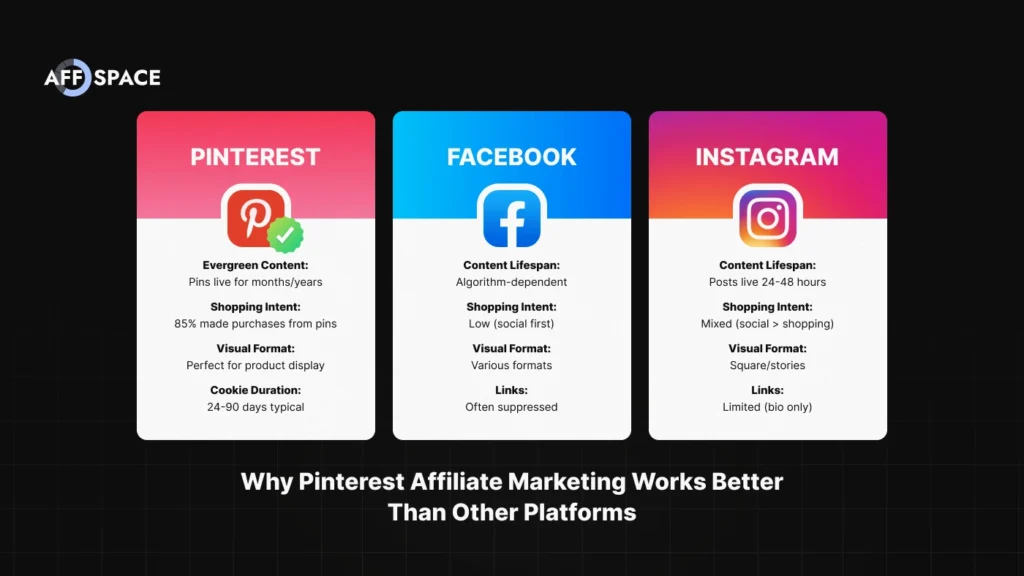
Unlike Instagram or Facebook where content vanishes quickly, Pinterest affiliate marketing works differently—it functions as a visual search engine where your content accumulates value over time. Users actively seek product recommendations rather than scrolling mindlessly, creating an environment where affiliate marketing on Pinterest feels natural instead of intrusive.
This Pinterest affiliate marketing guide walks you through building a profitable strategy from scratch—pin formats that convert, search optimization tactics that drive discovery, and monetization approaches that generate consistent commissions. Whether you’re exploring Pinterest affiliate marketing for beginners or refining existing campaigns, you’ll discover actionable tactics for 2026.
Why Pinterest Affiliate Marketing Changes Everything
Most affiliates wonder: how to do affiliate marketing on Pinterest differently than other platforms? The answer lies in user intent.
Pinterest users arrive with fundamentally different mindsets. According to Pinterest’s 2024 data, 85% of weekly users have purchased products they discovered on the platform—a conversion rate that makes Pinterest affiliate marketing more profitable than traditional social media approaches.
The real advantage of doing affiliate marketing on Pinterest lies in content longevity. That pin I mentioned earning $840? I posted it in March 2021. It got modest traction initially—maybe 2,000 impressions that month. By July, the algorithm had figured out who needed to see it, and impressions jumped to 28,000. Today, four years later, it still generates 5,000-8,000 monthly impressions and $150-300 in passive income. I haven’t touched it since the initial posting.
This is why a solid Pinterest affiliate marketing strategy focuses on evergreen content creation rather than constant posting. Compare this to Instagram where even successful posts lose visibility within 48 hours. Pinterest rewards quality content with sustained visibility that builds over time.
For context on how Pinterest affiliate marketing fits into broader affiliate approaches, our guide on types of affiliate marketing explores different promotional strategies across platforms.
Setting Up Your Pinterest Affiliate Marketing Foundation
Starting Pinterest affiliate marketing for beginners requires more than just creating an account and posting random pins. Strategic setup determines whether you build a sustainable traffic source or waste months on ineffective tactics.
Account Configuration That Signals Authority
Business accounts outperform personal accounts by 40-60% in impressions and clicks, even with identical content. This matters for Pinterest affiliate marketing because Business accounts unlock analytics that reveal what’s working, plus access to advertising options when you’re ready to accelerate growth.
Converting takes three minutes at business.pinterest.com—claim your website, enable Rich Pins, and access analytics. Rich Pins automatically sync information from your blog, creating more informative pins that the algorithm favors.
Profile optimization matters more than most realize when doing Pinterest affiliate marketing. Instead of generic descriptions like “Sharing things I love,” write something specific: “Helping young families design beautiful homes on tight budgets. Budget-friendly decor finds, DIY projects, and organization hacks that actually work.”
Notice the keyword integration—”budget-friendly decor,” “DIY projects,” “organization”—all terms my target audience searches for when researching products.
Board Organization That Captures Search Traffic
Here’s where most people starting Pinterest affiliate marketing go wrong: they create 3-4 broad boards like “Home Decor.” Pinterest rewards specificity.
Instead of one “Home Decor” board, I created fifteen targeted boards for my Pinterest affiliate marketing strategy: “Small Bedroom Organization Under $100,” “Farmhouse Kitchen Ideas on a Budget,” “DIY Wall Decor Projects.” Each board targets different search queries.
Board titles should include 2-3 keywords maximum while remaining natural. Board descriptions provide another optimization opportunity—write 100-150 characters explaining what the board contains, incorporating relevant keywords naturally.
Each board needs 15-30 pins before publishing. Empty boards signal low-quality accounts to the algorithm, hurting your efforts.
For guidance on selecting valuable partnerships when learning how to do affiliate marketing on Pinterest, check our article on choosing the best affiliate program to join.
Creating Pins That Drive Clicks and Commissions
Pin design separates Pinterest affiliate marketing accounts earning $100 monthly from those generating $2,000+. I’ve created over 3,000 pins and tracked what works.
Vertical Format That Pinterest Loves
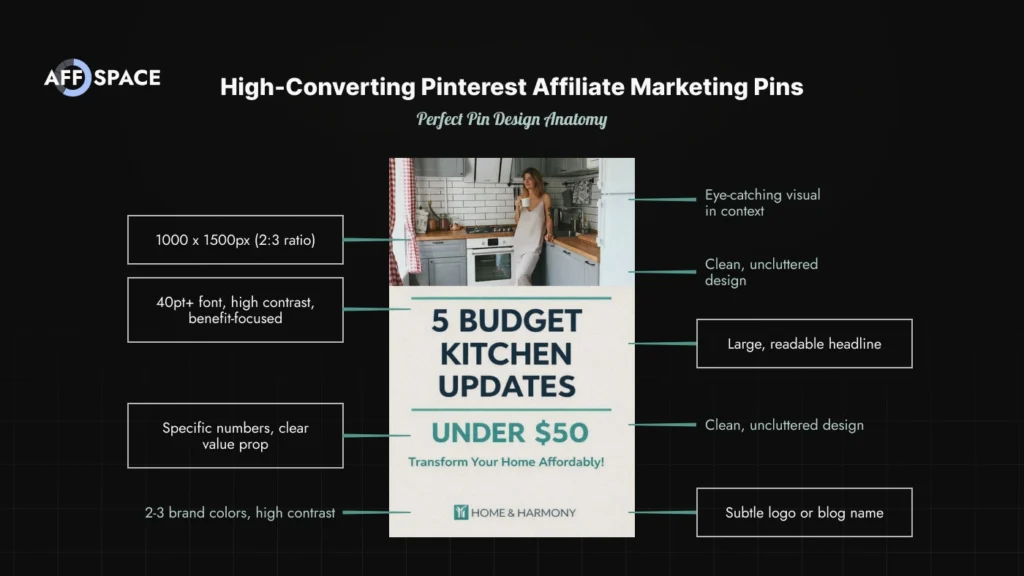
The ideal ratio for successful Pinterest affiliate marketing is 2:3 (1000 x 1500 pixels). Standard vertical pins consistently receive 60-80% more impressions than non-standard formats because they fit naturally into the feed.
Text Overlay Strategy That Stops the Scroll
Here’s what changed my Pinterest affiliate marketing results dramatically: treating pin headlines like compelling article titles rather than simple descriptions.
Bad headline: “Kitchen Organization Ideas” Better headline: “23 Genius Kitchen Organization Hacks Under $30” Best headline: “Transform Your Messy Kitchen for $47 (Even in Tiny Apartments)”
The best version works because it combines specificity ($47), outcome (transform messy kitchen), and addresses a common concern (works in small spaces). Numbers consistently outperform text without numbers—pins with specific quantities receive 30-40% more clicks in my testing.
Description Optimization for Search Discovery
The first 50-75 characters appear in feed view before users click “read more.” Front-load your most compelling copy and primary keyword here.
Example: “Transform your dated kitchen with these 5 budget farmhouse updates under $50 each! From DIY shiplap alternatives to vintage hardware, these affordable projects create rustic charm. Click for sources and installation tips!”
Descriptions work best at 250-350 characters. Use 3-5 highly specific hashtags rather than 15-20 generic ones. Every description needs a clear call-to-action: “Click to see the full tutorial” or “Shop these budget finds.”
Distribution Strategies That Build Momentum
Pinning Frequency and Timing
I tested various frequencies for Pinterest affiliate marketing: 5, 10, 15, 20, and 30+ pins daily. The sweet spot lands at 10-15 pins daily, spaced throughout the day. This demonstrates commitment without triggering spam filters.
Content mix affects algorithmic favor too. My ratio: 70% original pins (my blog content or products) and 30% repins from other quality creators.
The Fresh Pin Strategy
Pinterest doesn’t define “new” pins by URL—it defines them by image file. You can create ten different pin designs linking to the same blog post, and the platform treats each as fresh.
For Pinterest affiliate marketing success, identify your 10 best-performing posts or products. Create 5-10 different pin designs for each, varying colors, layouts, headlines, and imagery. Post one fresh design every 2-3 weeks per URL.
Seasonal Content Planning
Users plan ahead more than any other platform. Start creating and posting holiday content 90 days before the actual holiday. This lead time allows the algorithm to build momentum before demand peaks.
High-value seasonal opportunities: Holiday gift guides (September-November), New Year’s resolution products (October-December), Spring cleaning (January-March), Summer outdoor living (March-May), Back-to-school (June-August).
According to Pinterest’s official blog on seasonal marketing, brands that plan seasonal campaigns 45-60 days ahead see 2.3x higher engagement—essential knowledge for anyone learning how to do affiliate marketing on Pinterest.
Monetization Models for Pinterest Affiliate Marketing
Blog-to-Affiliate vs. Direct Linking
Most successful Pinterest affiliate marketing approaches drive traffic to blogs, then convert visitors to affiliate clicks. This method works best—blog-mediated pins convert at 3.4% in my tracking versus 1.8% for direct affiliate links.
However, direct pins require significantly less effort. Creating blog posts takes 4-6 hours each. Creating pins takes 15-20 minutes. The ROI calculation sometimes favors direct linking for visual products where benefits are immediately obvious: fashion, home decor, kitchen gadgets, beauty products.
Amazon Associates Considerations
Amazon’s 24-hour cookie window creates unique challenges for Pinterest affiliate marketing. With most programs offering 30-90 day cookies, Amazon credits only purchases within 24 hours.
Traffic converts to Amazon purchases well because users are actively researching. However, the 24-hour window still costs commissions—I estimate losing 20-30% of potential Amazon earnings to the compressed timeline.
For comprehensive Amazon strategies beyond Pinterest affiliate marketing, see our Amazon affiliate program guide.
Advanced Tactics for Higher Earnings
Search Engine Optimization
SEO differs fundamentally from Google. The search bar provides the best keyword intel. Start typing your topic and note autocomplete suggestions—these are real searches from real users.
Each search result page displays “Related Searches” horizontally across the top. The “Guided Search” filter buttons reveal how the platform understands your topic’s subcategories.
Analytics-Driven Optimization
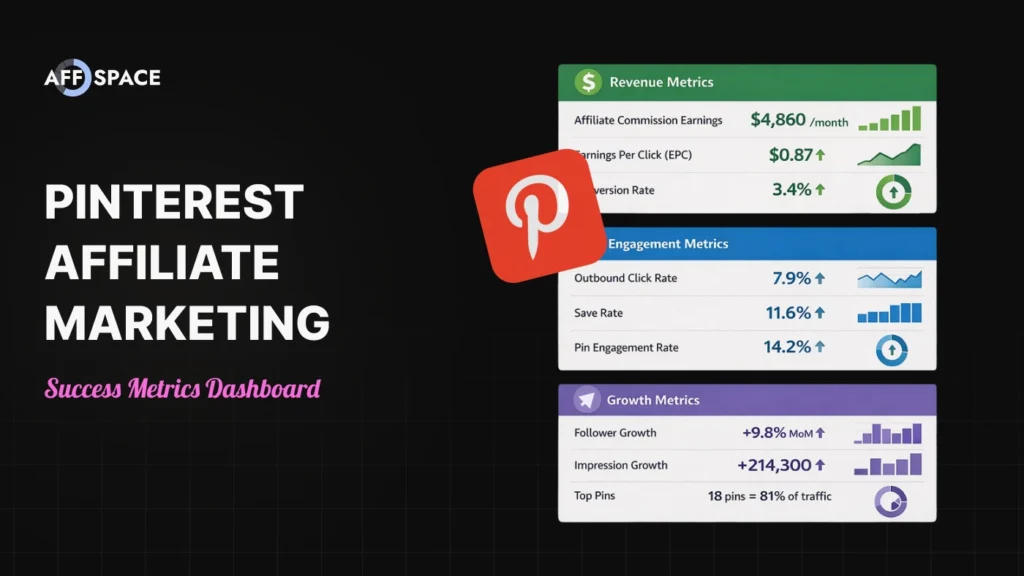
My monthly process: Export 90-day analytics, sort pins by outbound clicks, identify top 20% by clicks, analyze common characteristics among top performers, create 5-10 new variations, eliminate bottom 20%.
Track these metrics: Outbound Clicks (traffic driven to your sites), Saves (signals valuable content), Engagement Rate (saves + clicks ÷ impressions), Click-Through Rate (outbound clicks ÷ impressions).
Pinterest Affiliate Marketing Examples: Real Results
Budget Home Decor Case Study
This Pinterest affiliate marketing example demonstrates realistic timelines and earnings.
Strategy: Created 28 boards covering specific rooms. Posted 12-15 pins daily with bright colors and benefit-focused headlines.
Timeline: Months 1-3: $150-300 monthly. Months 4-7: $800-1,400 monthly. Months 8-12: $2,100-3,800 monthly. Current (18+ months): $3,800-5,400 monthly with 8-10 hours weekly maintenance.
Key takeaways from this Pinterest affiliate marketing example: Seasonal content generated 2-3x normal traffic during peaks. Product roundup posts consistently outperformed single reviews.
Sustainable Fashion Focus
Another successful Pinterest affiliate marketing example with a unique angle.
Strategy: Capsule wardrobe concept with styling guides showing multiple looks from few items.
Results: Slower initial growth (nine months to reach $1,000 monthly) but higher conversion rates (4.2% vs. 2.8%). Current income: $4,200-5,800 monthly.
Common Mistakes to Avoid
Over-Promotion: Follow 80/20 rule—80% genuinely helpful content and 20% promotion. Build trust through value before asking for clicks.
Ignoring Vertical Format: Non-vertical pins receive 40-60% less distribution. Always create Pinterest-specific 2:3 ratio pins.
Insufficient Pin Variety: Create 5-10 varied designs for each important URL, testing different headlines, colors, and imagery.
Poor Description Optimization: Write 250-350 character descriptions front-loading primary keywords and communicating specific value.
Best Affiliate Programs for Pinterest
When selecting the best affiliate programs for Pinterest, focus on visual products that naturally fit the platform:
Home Decor: Wayfair, Target, Pottery Barn—these convert exceptionally well because users actively seek home inspiration.
Fashion: Nordstrom, ASOS, Revolve—outfit inspiration drives strong conversions.
Beauty: Sephora, Ulta—tutorial content naturally incorporates product recommendations.
DIY: Michaels, Joann—project tutorials create perfect opportunities.
Amazon Associates: Universal product availability makes Amazon essential despite the 24-hour cookie.
Tools for Success
Canva Pro ($12.99/month): Essential with Pinterest-specific templates, brand kit storage, background removal. Creating 15 professional pins takes 30-45 minutes.
Tailwind ($12.99-49.99/month): Platform-approved scheduling with smart timing and analytics dashboard.
Pretty Links or ThirstyAffiliates ($79-199/year): Clean up affiliate URLs while providing detailed tracking.
For comprehensive tool comparisons, review our complete affiliate marketing tools guide.
Scaling to $5,000+ Monthly
Content Repurposing
One piece of content should generate 8-12 pins minimum: varied pin designs, Instagram carousel, YouTube short, weekly email, additional quote/statistic pins.
Strategic Expansion
Once you’ve established authority, expand into adjacent audiences. My budget home decor account expanded into: budget DIY projects, small space organization, rental-friendly improvements, seasonal decorating.
Diversification
Protect against platform dependency: Multiple traffic sources (Pinterest + Instagram + YouTube + email), varied programs (8-12 different partnerships), product category expansion, content portfolio (50+ active pins across topics).
For comprehensive diversification strategies, see our affiliate marketing strategy guide.
Building Long-Term Income
Pinterest affiliate marketing offers genuine path to substantial passive income for those willing to invest consistent effort over 6-12 months.
The compounding effect creates unique advantages. Each quality pin becomes a perpetual traffic asset generating returns for months or years. Accounts earning $3,000-8,000 monthly aren’t necessarily creating better pins—they’ve maintained consistency long enough for compounding effects to manifest.
Your timeline: invest 3-6 months establishing foundation, experience momentum months 6-12, reach stable income months 12-18+.
Whether exploring this alongside other channels or focusing exclusively on visual discovery, remember that authenticity and value always outperform purely promotional approaches.
For those ready to expand beyond this channel, explore our complete affiliate marketing guide covering essential skills and professional development. Success requires mastering multiple channels—this represents one powerful component in a diversified, sustainable business.
Frequently Asked Questions
Can you actually make money with Pinterest affiliate marketing?
Yes—I’ve generated over $180,000 through this channel since 2020. However, results require 6-12 months of consistent effort before substantial income develops. The platform rewards patience through evergreen traffic that compounds over time.
Do I need a website for affiliate marketing on Pinterest?
Not strictly required—the platform allows affiliate links in descriptions with proper disclosure. However, blog-mediated traffic converts 1.8-2.5x better in my testing. Most successful affiliates use blogs as their primary hub.
How long does it take to see Pinterest affiliate marketing results?
Most accounts need 3-6 months of consistent pinning before significant traffic develops. Expect $50-200 monthly in months 1-3, $200-800 in months 4-6, $800-2,500+ in months 7-12 with consistent implementation.
What are the best affiliate programs for Pinterest?
Home decor (Wayfair, Target), fashion (Nordstrom, ASOS), beauty (Sephora, Ulta), kitchen (Williams Sonoma), DIY (Michaels), fitness (Lululemon), and Amazon Associates all perform consistently well. Choose programs matching your niche.
How many pins should I post daily?
10-15 pins daily spaced throughout the day provides optimal consistency. Maintain 70% original content and 30% curated content ratio. Consistent daily activity matters more than volume.
Can beginners succeed with Pinterest affiliate marketing for beginners?
Absolutely—this platform offers beginner-friendly entry with no existing audience required, free traffic through search, and lower competition than Google. The key is realistic expectations about timeline (6-12 months) and commitment despite slow initial results.
Ready to launch your affiliate business on Pinterest? Join AFFspace today!
