

Types of Affiliate Marketing Explained: The Ultimate Guide

Affiliate marketing has grown into one of the most versatile and effective strategies for generating revenue online. From individual content creators to large corporations, understanding the different types of affiliate marketing is essential for achieving sustainable growth. Each type offers distinct advantages, challenges, and strategies that affect conversion rates, audience trust, and long-term profitability.
There are several types of affiliate marketing, each offering unique opportunities: understanding their structure is essential. In this guide, we’ll explore the main affiliate marketing types, including Unattached, Related, and Involved, as well as platform-based approaches and compensation models. By the end, you’ll know how to choose the type that fits your affiliate marketing niche, skills, and audience.
Each of these affiliate marketing types serves a distinct purpose, catering to marketers with different goals, levels of expertise, and target audiences.
What Are the Main Types of Affiliate Marketing?
Affiliate marketing can be categorized based on the relationship the affiliate marketer has with the products they promote. These categories also correlate with trust levels, scalability, and conversion potential. The main types of affiliate marketing models are used by both beginners and professionals:
- Unattached Affiliate Marketing: Affiliates have no personal experience with the product; promotion is purely transactional.
- Related Affiliate Marketing: Affiliates promote products relevant to their niche audience, even if they haven’t personally used them.
- Involved Affiliate Marketing: Affiliates only promote products they have personally used and tested, generating the highest conversion rates.
Understanding these distinctions helps marketers select strategies aligned with their expertise, audience relationships, and long-term goals.
Unattached Affiliate Marketing
Unattached affiliate marketing is the most transactional form of promotion. Affiliates in this category do not have personal experience or authority over the products they promote. Their focus is on generating traffic and conversions via paid channels rather than building trust with an audience.
Key Features
- Traffic-driven rather than relationship-driven.
- Heavy use of PPC campaigns, display ads, and programmatic advertising.
- Works well for broad-market products or low-commitment items, like software utilities, consumer electronics, and trending gadgets.
Advantages
- Highly scalable once campaigns are optimized.
- Can promote multiple products across various niches without deep subject knowledge.
- Automation is possible through affiliate networks and programmatic tools.
Challenges
- Conversion rates tend to be lower due to the lack of personal recommendation.
- Requires significant upfront investment in paid advertising.
- Strong competition from other affiliates and marketers using similar ad platforms.
Best Use Cases
- Affiliates who view marketing as a paid traffic business rather than content-based strategy.
- Ideal for digital products or subscriptions, where traffic volume is more important than personal endorsement.
Example Workflow
- Identify a high-volume niche, such as productivity software.
- Join affiliate programs with broad appeal and PPS (Pay-Per-Sale) models.
- Launch PPC campaigns targeting buyer-intent keywords.
- Test multiple ad creatives, targeting options, and landing pages.
- Scale successful campaigns across platforms like Google Ads, Bing Ads, or programmatic networks.
Case Study: A tech affiliate ran Google Ads promoting antivirus software. They drove 50,000 clicks in one month and converted 2% into subscribers, generating $12,000 in commissions.
Related Affiliate Marketing
Related affiliate marketing bridges the gap between transactional promotion and authentic endorsement. Affiliates promote products relevant to their niche and audience, even if they haven’t personally used every item.

Key Features
- Products align with audience interests and niche content.
- Integrates naturally into blogs, YouTube channels, or niche websites.
- Includes content like “best-of” lists, tutorials, comparisons, and guides.
Advantages
- Balances audience trust with scalability.
- Typically higher conversions than unattached marketing due to relevance.
- Allows expansion into multiple products or categories without personal experience.
Challenges
- Maintaining authenticity is challenging if the affiliate hasn’t personally tested the product.
- Requires research and vetting to ensure product quality.
- Audience engagement may decline if promotions feel insincere.
Best Use Cases
- Among different types of affiliate marketing, this one suits established content creators with niche audiences.
- Monetizing via relevant recommendations without testing every product personally.
Example Workflow
- Analyze audience needs and niche interests.
- Choose affiliate programs that provide relevant products.
- Create “best-of” lists or tutorials integrating affiliate links.
- Track engagement, clicks, and conversions to optimize content.
- Update recommendations periodically to reflect new products and trends.
Case Study: A fitness blogger created a guide on protein powders. Even without testing every product, their in-depth research and audience focus led to a 5% conversion rate, generating $8,000 in three months.
Involved Affiliate Marketing
Involved affiliate marketing is the most authentic form of promotion, where affiliates only recommend products they have personally used and tested.
Key Features
- Focus on personal experience and genuine recommendations.
- Content includes detailed reviews, tutorials, case studies, and insights.
- Builds a strong personal brand and loyal audience.
Advantages
- Highest conversion rates among all affiliate types.
- Strengthens long-term audience trust.
- Opens doors for exclusive partnerships and higher commissions.
Challenges
- Less scalable than unattached marketing.
- Requires hands-on product experience.
- Content creation is more time-intensive.
Best Use Cases
- Content creators, influencers, or educators prioritizing credibility over short-term gain.
- High-ticket or niche products where audience trust is essential.
Example Workflow
- Use and test products personally.
- Create detailed reviews, tutorials, and case studies.
- Share personal insights and tips.
- Negotiate higher commission rates with merchants.
- Engage with the audience to maintain credibility.
Case Study: A tech reviewer tested 10 laptops and created comprehensive YouTube guides. Audience trust led to a 12% conversion rate, generating $20,000 in six months.
Choosing the right affiliate marketing types can help creators and businesses achieve long-term growth while maintaining trust and authenticity with their audiences.
Types of Affiliate Marketers by Platform
Apart from the three main categories, there are platform-based types of affiliate marketing, depending on how affiliates promote products. Understanding these types helps marketers select strategies aligned with their skills.
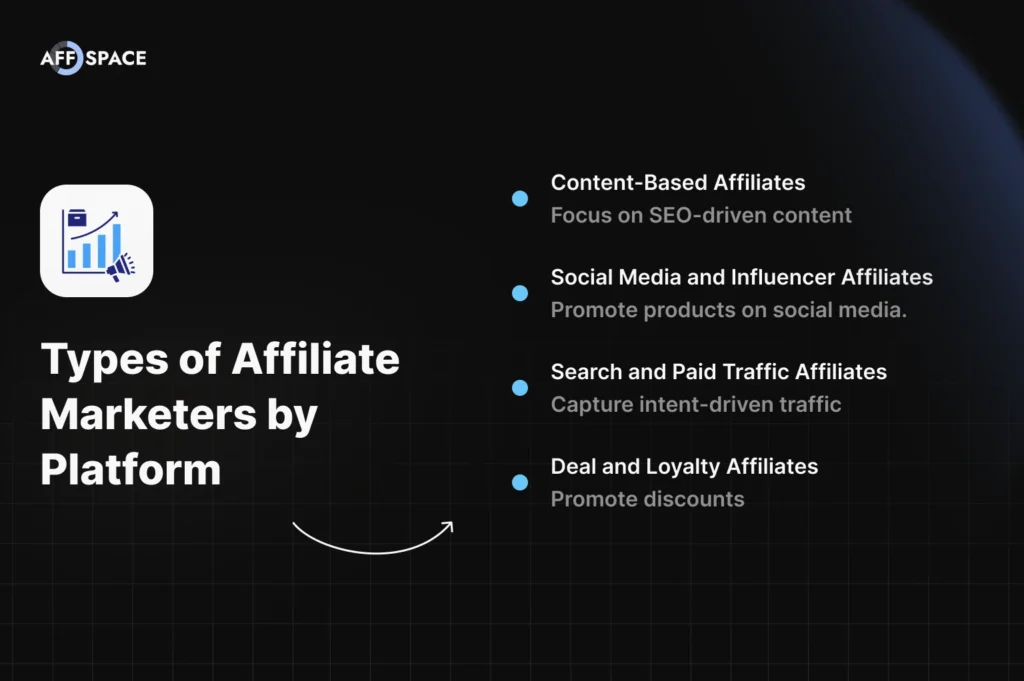
Content-Based Affiliates
- Bloggers, review sites, and niche websites.
- Focus on SEO-driven content to attract users searching for solutions.
- Produce in-depth tutorials, comparison posts, and case studies.
Social Media and Influencer Affiliates
- Promote products on Instagram, TikTok, Facebook, YouTube, Pinterest.
- Use unique promo codes or affiliate links for tracking.
- Micro-influencers: smaller but highly engaged audiences, higher conversions.
- Celebrity influencers: broad reach, less personal engagement.
Search and Paid Traffic Affiliates
- Capture intent-driven traffic via search engines and paid ads.
- Includes SEO sites, PPC campaigns, and mobile app promotions.
- Requires technical expertise in campaign management and analytics.
Deal and Loyalty Affiliates
- Promote discounts, cashback offers, and flash deals.
- Target price-sensitive audiences.
- Often achieve higher conversions due to immediate value.
Traditional and Corporate Affiliates
- Use offline media, partnerships, or high-traffic platforms.
- Manage large affiliate networks with sophisticated tracking.
- Includes B2B and enterprise programs with long-term partnership focus.
Types of Affiliate Marketing by Compensation Model
Affiliate programs differ widely in how they compensate affiliates, and this payment structure directly affects marketing strategies, risk levels, and income predictability. Understanding the current trends in affiliate marketing spending can help affiliates choose the most profitable models. According to affiliate marketing industry statistics, the global affiliate marketing industry continues to grow steadily, with projections reaching billions of dollars annually. Many successful marketers combine types of affiliate marketing to diversify income and reduce dependency on a single revenue stream.
Understanding various affiliate marketing models enables affiliates to build sustainable income streams and choose programs that best fit their promotional strategy.
Pay-Per-Sale (PPS)
Definition: Pay-per-sale (PPS) is the most common affiliate compensation model. Affiliates earn a commission only when a referred customer completes a purchase. This is one of the most popular affiliate marketing compensation models for a reason.
How It Works:
- Affiliates generate traffic through content, ads, or social media promotion.
- A visitor clicks the affiliate link and makes a purchase on the merchant’s website.
- The affiliate receives a percentage of the sale price.
Typical Use Cases:
- Digital products like online courses, software subscriptions, or e-books.
- Physical products, such as electronics, household items, or apparel.
Advantages:
- Aligns affiliate and merchant incentives: both parties want the sale.
- Often provides higher payouts than other models because it rewards actual revenue generation.
- Works well with content-driven marketing, where product reviews and tutorials can drive conversions.
Challenges:
- Income depends entirely on completed sales, which can be unpredictable.
- High competition in popular niches may require significant effort to rank content or optimize ads.
- Requires careful targeting of traffic to maximize conversion rates.
Example:
- Amazon Associates Program: Offers commissions between 1–10% depending on the product category. A tech blogger writing a laptop review may earn 5% per sale. If one post generates 50 laptop sales at $1,000 each, the affiliate earns $2,500 from that post alone.
Strategic Tips:
- Focus on high-intent keywords in SEO content, such as “best [product] review” or “[product] vs [competitor].”
- Highlight product benefits, comparisons, and tutorials to guide visitors toward purchasing.
- Combine PPS with limited-time deals or bonuses to boost urgency and conversions.
Pay-Per-Lead (PPL)
Definition: Pay-per-lead (PPL) compensates affiliates for generating qualified leads rather than completed sales. A lead may be a signup, registration, consultation request, or trial subscription.
How It Works:
- Affiliates drive targeted traffic to a landing page or form.
- Visitors complete a specific action defined by the merchant, such as filling out a signup form.
- The affiliate earns a fixed commission per qualified lead.
Typical Use Cases:
- SaaS products offering free trials.
- Insurance or financial services requiring consultation forms.
- Subscription-based services needing email signups.
Advantages:
- Lower barrier to entry compared to PPS: affiliates don’t need a visitor to complete a purchase.
- Predictable revenue per lead, which is easier to scale with targeted campaigns.
- Works well for high-value or long sales-cycle products, where lead acquisition is more critical than immediate sales.
Challenges:
- Leads must meet merchant quality criteria; low-quality submissions may be rejected.
- Often requires careful audience targeting to ensure leads are relevant.
- Lower payout potential per lead compared to high-ticket sales.
Example:
- An affiliate promoting an online learning platform might earn $15 per signup for free trial registration. Driving 1,000 signups per month generates $15,000 in revenue without requiring all users to convert to paid subscriptions immediately.
Strategic Tips:
- Create content like lead magnets, free guides, and webinars to attract qualified leads.
- Use email marketing to nurture potential leads toward completing the required action.
- Focus on high-intent audiences, such as those actively researching a solution in your niche.
Pay-Per-Click (PPC)
Definition: In pay-per-click (PPC) programs, affiliates earn a commission for each click on their affiliate link, regardless of whether the visitor makes a purchase or completes any further action.
How It Works:
- Affiliates promote products via ads, email campaigns, or content with embedded links.
- Each visitor click is tracked, and the affiliate earns a predetermined fee per click.
Typical Use Cases:
- High-traffic websites or blogs monetizing general audience clicks.
- Comparison and discovery platforms where clicks to merchant sites generate value.
- Mobile apps or promotional campaigns requiring volume-based traffic.
Advantages:
- Provides immediate income from traffic, without depending on sales or leads.
- Simple to understand and easy to track performance.
- Effective for affiliates who can generate high-volume traffic.
Challenges:
- Lower payouts per click compared to PPS or PPL, requiring massive traffic volume to generate significant income.
- Success depends on optimizing CTR (click-through rate) and attracting relevant traffic.
- Risk of low-quality traffic, click fraud, or bots reducing earnings.
Example:
- A coupon site may earn $0.25 per click on offers sent to visitors. Driving 100,000 clicks in a month can generate $25,000 even if only a fraction converts into sales.
Strategic Tips:
- Target high-traffic keywords with broad appeal.
- Combine with A/B testing for landing pages and call-to-action buttons.
- Integrate PPC with retargeting campaigns to maximize conversions beyond clicks.
Two-Tier Affiliate Marketing
Definition: Two-tier affiliate programs allow affiliates to earn commissions not only from direct sales but also from recruiting other affiliates into the program.
How It Works:
- Affiliates promote products like in PPS or PPL.
- In addition, they recruit new affiliates under their network.
- Affiliates earn a percentage of the new affiliate’s commissions, creating a passive income layer.
Typical Use Cases:
- Network marketing, subscription services, and SaaS platforms.
- Programs focused on scaling the affiliate network quickly.
Advantages:
- Generates passive income from recruits.
- Encourages affiliates to build networks, amplifying reach for the merchant.
- Can create exponential growth potential if affiliates actively recruit others.
Challenges:
- Success depends on recruiting motivated, high-performing affiliates.
- Can attract affiliates who focus more on recruitment than actual product promotion.
- Complex tracking may require robust affiliate network tools.
Example:
- A software subscription affiliate earns $50 per referral. They recruit 5 affiliates who each make $1,000 in commissions monthly. The original affiliate earns 10% ($100) of each recruit’s earnings, adding up to $500 in passive income on top of their own sales.
Strategic Tips:
- Provide recruits with training and resources to increase productivity.
- Focus on affiliates with similar niche audiences for better alignment.
- Monitor network performance and optimize commission structures to incentivize active promotion.
Influencer Affiliate Marketing
Definition: Influencer affiliate marketing relies on authentic engagement and social authority. Influencers leverage their trusted relationship with followers to promote products.
How It Works:
- Influencers share products via social media posts, stories, videos, or live streams.
- Followers use unique promo codes or affiliate links to track conversions.
- Commissions are earned based on sales, leads, or clicks, depending on the program.
Typical Use Cases:
- Lifestyle, fitness, fashion, beauty, tech, or niche influencers.
- Influencers with engaged audiences who value recommendations.
- Platforms include Instagram, TikTok, YouTube, and Pinterest.
Advantages:
- High conversion rates due to audience trust and relationship.
- Access to exclusive promotions, higher commission tiers, or brand collaborations.
- Works well for product launches, seasonal campaigns, and limited-time promotions.
Challenges:
- Requires authentic engagement to maintain credibility.
- Over-promotion may harm follower trust.
- Audience size does not always correlate with conversion potential—engagement matters more than followers.
Example:
- A fitness influencer with 50,000 engaged followers promotes a protein supplement with a 10% commission. Each post generates 200 sales at $50 each, totaling $1,000 per post. Bonus incentives may increase earnings if sales exceed certain thresholds.
Strategic Tips:
- Prioritize products you personally use to maintain authenticity.
- Track engagement metrics, not just follower count, to optimize ROI.
- Mix sponsored and organic content to avoid audience fatigue.
Best Practices for Affiliate Marketing Success
Choosing between the different types of affiliate marketing is just the first step. To ensure long-term success across any model, follow these core best practices:
- Know your audience: Align products with their interests and needs.
- Monitor performance: Track CTR, conversion rates, and revenue.
- Diversify strategies: Don’t rely on a single affiliate marketing type. Use multiple platforms and compensation models to build a resilient business.
- Build trust: Provide genuine, valuable content.
- Stay updated: Keep up with affiliate trends, tools, and regulations.
Conclusion: Choosing the Right Types of Affiliate Marketing for Your Program
Understanding the different types of affiliate marketing is crucial for building a sustainable online income. As we’ve explored, from the hands-off unattached affiliate marketing to the trust-based involved affiliate marketing, each type offers unique paths to profitability. The key is to match your approach—whether you’re a content-based affiliate, a social media affiliate, or a paid traffic expert—with your skills and audience’s needs. Furthermore, selecting the right affiliate marketing compensation model, be it PPS, PPL, or PPC, is fundamental to your strategy. By carefully selecting your affiliate marketing type and leveraging the best platforms, you can create a profitable and enduring affiliate marketing business.
