

High Ticket Affiliate Marketing: Complete Guide to Earning Big Commissions
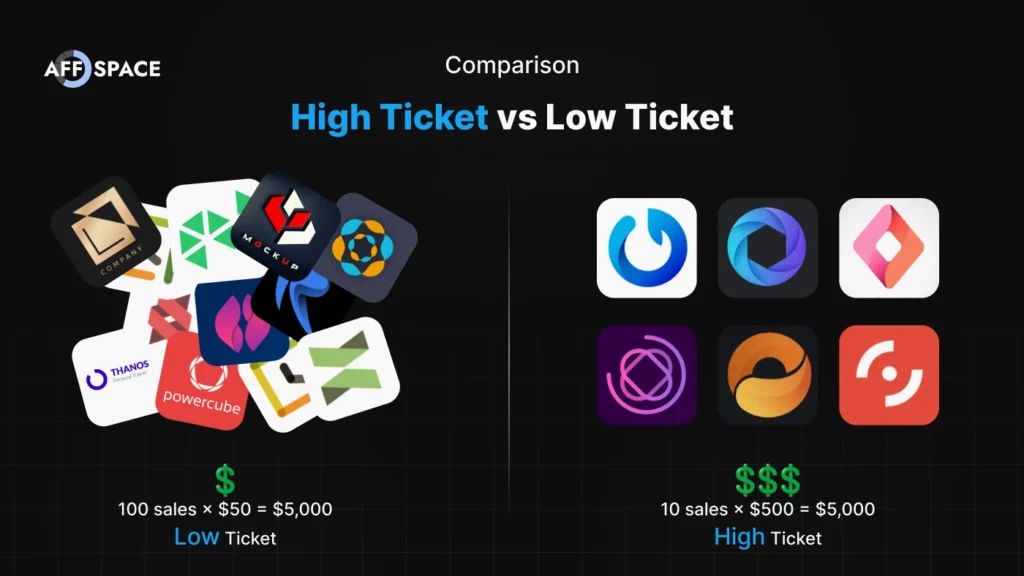
The affiliate marketing landscape has shifted dramatically over the past decade, and one model stands out for producing substantial income without requiring massive traffic volume: high ticket affiliate marketing. While standard affiliate programs pay $20–50 per conversion, high ticket programs reward you with $500 to $10,000 or more per sale.
This guide covers everything — from understanding the fundamentals to the monitoring and software niche that most high ticket guides skip entirely, where commission structures quietly outperform most of the categories everyone else is fighting over.
What Is High Ticket Affiliate Marketing?
High ticket affiliate marketing is a model where affiliates promote premium products or services — typically priced at $500 or more — and earn substantial commissions per sale, often $200 to $10,000+. Unlike volume-driven models that require hundreds of small commissions, high ticket affiliate marketing generates significant income from a small number of well-qualified conversions.
Three things define a high ticket program: the product price (generally $500+), the commission value per sale (generally $200+), and the customer decision process. These aren’t impulse purchases — they’re considered investments that buyers research carefully, which means how affiliate marketing works at the content and trust level matters far more than clever copywriting.
⚠️ High Ticket Reality Check
The Truth: You won’t make $5,000 tomorrow. But you can make $5,000 with 10 sales instead of 500.
Key Characteristics of High Ticket Affiliate Marketing
Premium pricing with justified value. Products range from $500 to $50,000+. Buyers evaluate ROI, not price tags — they’re asking “what problem does this solve and is it worth what it costs?” not “can I afford this?”
Higher commission per conversion. A 30% commission on a $3,000 product yields $900 versus $9 on a $30 product. The content effort required to earn one conversion doesn’t scale linearly with commission size — which is the entire structural argument for high ticket affiliate marketing.
Longer sales cycles. Prospects may take weeks or months. Plan content and email sequences for 30–90 day decision windows, not same-session conversions.
Trust-dependent conversion. Authority, track record, and recommendation specificity determine whether someone buys — not promotional language.
Is High Ticket Affiliate Marketing Legit?
Yes. High ticket affiliate marketing operates on the same structure as any performance-based affiliate arrangement. Major companies — HubSpot, Salesforce, Shopify, and hundreds of SaaS businesses — run high ticket affiliate programs as core customer acquisition channels.
Two things create legitimate concerns about the model, and neither is about the model itself:
Promoting products without genuine knowledge. A $5,000 course recommendation from someone who hasn’t taken it is a fundamentally different risk than recommending a $30 book. The trust required to convert a high ticket sale is identical to the trust permanently destroyed when a recommendation fails. Experienced buyers in premium niches have well-calibrated skepticism — superficial familiarity collapses under their questions.
Confusion with MLM. True affiliate marketing pays for referred sales only. No inventory, no recruitment requirement, no downline. If a program compensates you for recruiting affiliates rather than generating sales, it’s not affiliate marketing regardless of how it’s positioned.
The practical test: would you recommend this product to someone you respect without mentioning the commission? If yes, the recommendation is legitimate.
Why High Ticket Affiliate Marketing Works in 2026
Several structural factors make this the right moment for high ticket affiliate marketing:
Normalised high-value online purchases. Consumer comfort with spending thousands online — on courses, software, coaching — has increased substantially. The $3,000 purchase that felt risky in 2018 feels routine in 2026.
Trust in specialist content. Audiences have become better at distinguishing genuine expertise from promotional content. When a specialist recommends a high-ticket solution with specificity and evidence, the conversion rate on that recommendation is meaningfully higher than a generic endorsement.
Recurring commission structures. A growing number of high ticket programs — particularly in software — now combine upfront CPA payments with recurring RevShare on subscriptions. This changes the economics significantly: the commission math at month 12 looks nothing like month 1. This is covered in detail in the recurring commission affiliate programs guide.
5 High Ticket Niches That Pay $1K+ Per Sale (2026)

Not all niches are created equal. The strongest high ticket affiliate marketing niches serve buyers with established budgets and solve problems where the cost of not solving them is significant. Understanding the different types of affiliate marketing helps you choose the right approach for each.
1. Business Software and SaaS
Enterprise and mid-market software — CRM systems, marketing automation, project management suites — commands high ticket commissions because businesses have allocated tool budgets and quantify ROI explicitly. Referral commissions for platforms like HubSpot, Salesforce, and similar tools routinely run $500–$2,500 per sale.
- Commission range: $500–$2,500+ per sale, plus recurring
- Target audience: Business owners, marketers, sales professionals
- Best for: Affiliates with B2B context and operational knowledge
2. Online Education and Professional Certification
Business coaching, technical certifications, and professional training at the $2,000–$20,000 price point. Commission rates of 30–50% generate $600–$10,000 per conversion. The conversion requirement: you must have credibly experienced or deeply researched what you’re recommending. Thin familiarity shows immediately to buyers making five-figure decisions.
- Commission range: $300–$5,000+ per sale
- Target audience: Professionals seeking skills, entrepreneurs
- Best for: Practitioners who can verify outcomes from personal experience
3. Financial Services and Investment
Business financing, investment platforms, accounting software, and business banking. High lifetime value because financial service customers stay for years. Requires genuine expertise or at minimum credibility established through published content in the financial space.
- Commission range: $200–$1,500+ per qualified lead or sale
- Target audience: Business owners, investors, high-net-worth individuals
4. Health and Wellness
Premium health programs, medical services, and wellness retreats at $500–$5,000+. High-converting when the affiliate has personal experience or professional credibility. Verify refund rates before committing content resources — this category can run high.
- Commission range: $250–$3,000+ per sale
- Target audience: Health-conscious consumers with disposable income
5. Monitoring and Software — The High Ticket Niche Most Guides Skip
This is the category most high ticket affiliate marketing roundups miss entirely, and that omission is a real opportunity. Parental control software, employee monitoring tools, and digital safety applications sit in an unusual structural position: subscription products with high retention rates, relatively low affiliate competition, and commission structures that combine upfront CPA payments with recurring RevShare.
The retention dynamic is what elevates this niche beyond its initial appearance. In education or coaching, a customer buys once and the transaction is complete. In subscription monitoring software, a customer who signs up in January is still generating commission in December — and the commission compounds as your active subscriber base grows.
The recurring commission programs guide covers the 12-month math in detail, but the headline figure is relevant here: the same 120 conversions that produce $6,000 under pure CPA at $50 per sale produce approximately $19,700 under a hybrid CPA + RevShare structure at 90% monthly retention. The program structure triples the outcome from identical traffic.
High Ticket Affiliate Programs in the Monitoring and Software Niche
AFFspace operates an in-house affiliate program for 35+ monitoring, parental control, and digital safety software products. The commission structure is designed specifically for affiliates who want both upfront payout certainty and long-term recurring income — the combination that makes high ticket affiliate marketing sustainable rather than feast-or-famine.
The commission options:
CPA: $50 per first sale. Predictable, clean. Ten conversions = $500 in the month they close.
RevShare: 45% on the first transaction (average order ~$80 = $36 per conversion) + 25% on every rebill (typically $99/month subscription = $24.75/month per active subscriber).
Hybrid — CPA and RevShare simultaneously: $50 on first sale + 25% RevShare on all subsequent rebills.
12-month hybrid projection at 10 conversions/month, 90% monthly retention:
| Month | CPA income | RevShare base | Monthly total |
| 1 | $500 | $247 | $747 |
| 3 | $500 | ~$721 | ~$1,221 |
| 6 | $500 | ~$1,160 | ~$1,660 |
| 12 | $500 | ~$1,780 | ~$2,280 |
| 12-month total | ~$19,700 |
The 120-day cookie is what makes SEO content work in this niche. A reader who finds your review in January and subscribes in April still attributes to your account — and on RevShare, earns commission every month after. For content affiliates building SEO traffic, this is the structural requirement most high ticket programs fail to meet.
Approval is a form application — no phone interview, no minimum traffic threshold. Every partner gets a dedicated affiliate manager rather than a support ticket queue.
High Ticket Affiliate Programs Comparison Table
| Niche | Example Programs | Commission Range | Cookie | Model |
|---|---|---|---|---|
| Software & Monitoring ⭐ | AFFspace | $50 CPA + 25% rebills | 120 days | CPA + RevShare |
| Business SaaS | HubSpot, Monday.com | $500–$2,500/sale | 90 days | CPA |
| Online Education | Teachable, Kajabi | 30–50% / $600–$10K | 30–90 days | CPA |
| Financial Services | FreshBooks, Xero | $200–$1,500/sale | 30 days | CPA |
| Web Hosting | WP Engine, Kinsta | $100–$1,000+ | 60–180 days | CPA + recurring |
| Professional Services | Coaching, consulting | $500–$10,000/referral | Varies | CPA |
The software and monitoring row leads not because its per-sale commission is the highest in absolute dollar terms, but because the combination of recurring structure, 120-day cookie, and high subscription retention produces the strongest 12-month yield per conversion for SEO and content affiliates.
Best High Ticket Affiliate Marketing Programs
When selecting programs to promote, knowing how to choose the best affiliate program matters more than chasing headline commission rates.
HubSpot: Tiered commissions up to $1,000 per sale plus recurring revenue for ongoing subscriptions. Plans range from $500 to $5,000+ annually. The free CRM creates a natural upgrade path that reduces conversion friction considerably.
Shopify Plus: Revenue sharing or bounty commissions ranging from $500 to $2,000+ per referral. Best for e-commerce consultants and digital agencies whose clients are scaling past standard Shopify plans.
Teachable and Thinkific: 30% recurring commissions on platform subscriptions. Better suited to affiliates whose audiences include course creators than those promoting courses directly.
ClickFunnels: 40% recurring commissions on software at $147–$297/month. Recurring structure means a single referral generates meaningful lifetime value — but evaluate the audience fit carefully before committing content resources.
WP Engine: Up to $200 per referral plus 35% recurring commissions. High customer retention in managed hosting translates directly to compounding commission income for web developer and digital agency audiences.
AFFspace: As detailed above — hybrid CPA + RevShare structure, 120-day cookie, monitoring and software niche. The only program on this list with in-house product ownership, which removes the advertiser middle layer and gives you direct access to real conversion data and a dedicated account manager.
High Ticket Affiliate Marketing for Beginners: Where to Start
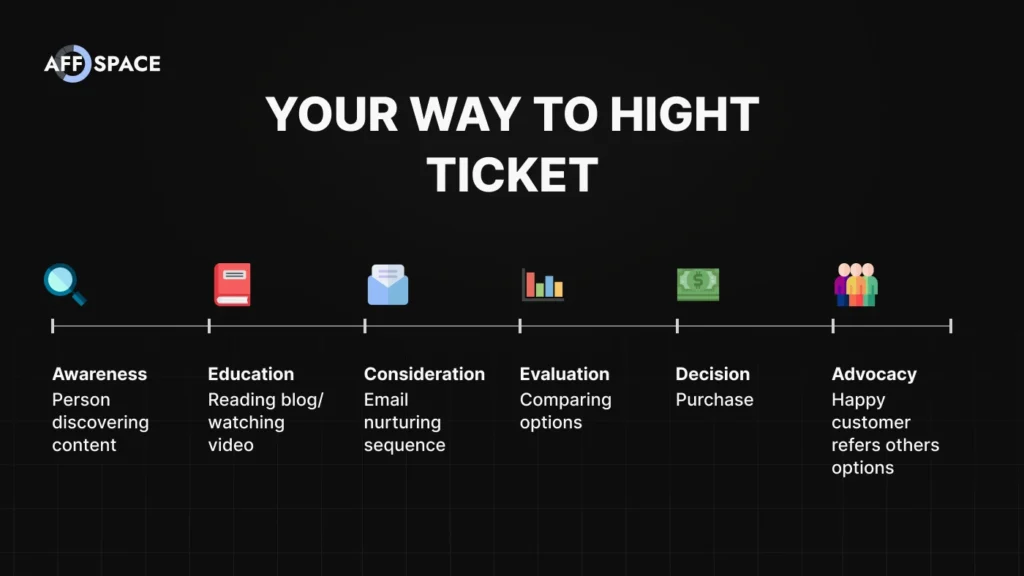
The entry barrier to high ticket affiliate marketing is not financial — it’s credibility. The affiliate who converts a $5,000 purchase is one whose audience trusts them specifically on that topic. Building that trust is the foundational task. See the complete guide on how to become an affiliate marketer for the full framework.
Step 1: Choose your niche based on knowledge, not just commission rates
High ticket affiliate marketing for beginners works best when the niche matches existing knowledge. Content that converts at this level is specific — it references real problems, real use cases, and real outcomes that only come from actual familiarity. If you’re building from scratch, choose a niche and invest in it before promoting it. See the guide to finding your perfect affiliate marketing niche for selection criteria.
Step 2: Build a platform around value
A professional website is the foundation. Email is the critical second layer — no other channel lets you nurture a prospect across 30–60 days the way email sequences do, and 30–60 days is the realistic decision timeline for most high ticket purchases. Budget constraints aren’t a barrier here: the no-money affiliate marketing guide maps a practical path from zero investment to first commission.
Step 3: Create trust before asking for it
One comprehensive, honest review of a high ticket product — grounded in real experience or deep research — generates more commissions than dozens of superficial posts. Understanding what affiliate links are and disclosing them properly is also foundational to the trust you’re building.
Step 4: Master the nurturing timeline
Plan for prospects to encounter your content 7–15 times before they’re ready to commit. Email sequences, retargeting campaigns, and direct engagement all matter more at this price point than in volume-based models. According to Salesforce’s State of the Connected Customer research, 95% of purchase decisions involve multiple touchpoints — a single article visit rarely converts a high ticket sale on its own.
My First $2,100 Commission (And What I Almost Did Wrong)
In April 2024, I earned my first high-ticket commission: $2,100 from a single $7,000 sale. Here’s the full story — including the mistakes that almost cost me the deal.
The Setup (January–March 2024)
I joined a business coaching program in January. It cost $7,000. I hesitated three weeks before committing. Why I finally bought: I had followed the coach for 8 months, I saw specific case studies with verifiable outcomes, and the program addressed my exact problem — scaling from $2K to $10K monthly. I documented everything after joining: every win, every struggle, every implementation.
The Lead (Late March)
I published a 3,000-word article: “How I Scaled My Affiliate Income from $800 to $4,200/Month in 90 Days.” I mentioned the coaching program once — in the context of what helped me break through. A reader named Sarah commented: “Which program did you join? I’ve been stuck at $1,500/month for six months.”
The Nurturing (Six Weeks)
Week 1: I replied to her comment with specific advice. No pitch. Just answered her question about traffic sources.
Week 2: She emailed through my site. I sent her my “Top 5 Scaling Strategies” PDF — free, no opt-in required.
Weeks 3–4: She replied with questions. I answered each one thoroughly. No mention of the coaching program.
Week 5: She asked directly: “You mentioned a program that helped you. Was it worth the investment?”
Week 6: I sent my honest review — pros and cons. I told her it was expensive and not for everyone. I included my affiliate link.
The Close — And What I Almost Got Wrong
Sarah clicked the link and visited the sales page. She didn’t buy immediately. I almost sent a follow-up: “Did you buy? The price goes up tomorrow.” That would have ended it. High-ticket buyers sense desperation and it reads as the affiliate’s priority overriding the buyer’s decision timeline.
Instead, I waited. Two days later she emailed: “I joined. Your review was the deciding factor — especially the part about the weekly accountability calls.” She bought the $7,000 program. My commission: $2,100 (30%).
Three things I’d do differently:
Bridge page. I sent her directly to the sales page. If she had bounced, she was gone. Now I use a bridge page that pre-sells and captures email before sending anyone to an affiliate sales page.
Bonus offer. Another affiliate offered a 1-hour strategy session as a bonus. Sarah nearly bought through them instead. Every high-ticket recommendation now has an exclusive bonus attached.
The patience test. Aggressive follow-up in week one would have ended the relationship. High-ticket sales need space — the buyer is doing their own due diligence and an impatient affiliate signals that the recommendation is more about the commission than the outcome.
The math that matters:
That $2,100 commission equalled 105 sales of a $20 product, 42 sales at $50, 21 sales at $100. And it came from less traffic than any of those alternatives would have required.
High Ticket Affiliate Marketing Examples: What Actually Works
The SaaS reviewer. A digital marketing consultant built comparison articles for project management and CRM tools — video walkthroughs, honest pros and cons, real use case examples. 50–60 active referrals generating $15,000+ monthly in recurring commissions. The specificity of the reviews, not the volume of content, was the mechanism.
The course buyer turned affiliate. Invested $10,000 in a business coaching program, documented real results, became an affiliate. 20 referrals over 18 months at $2,000 commission each — $40,000 total. Authentic storytelling about personal transformation was the entire conversion mechanism.
The monitoring niche content publisher. SEO affiliate building review content in the parental control and employee monitoring software space. Lower competition than mainstream SaaS, high buyer intent from parents and business owners actively searching for solutions. AFFspace’s 120-day cookie covered the weeks-long research-to-purchase window. RevShare rebills from retained subscribers created income that grew without additional content production.
The LinkedIn B2B authority. Published consistently about social selling, promoted LinkedIn Sales Navigator and related tools to a predisposed audience. $5,000–$8,000 monthly from high ticket affiliate programs specifically matched to platform expertise.
How to Start High Ticket Affiliate Marketing: 3-Month Action Plan
Month 1 — Foundation
Weeks 1–2: Niche selection, competitor research, program identification. Evaluate 5 programs against the 7-criteria framework in the program evaluation guide.
Weeks 3–4: Website setup, 3–5 foundational content pieces addressing major audience problems, email infrastructure, lead magnet creation.
Month 2 — Content and audience
Four to six additional articles targeting commercial intent keywords. Email welcome sequence (minimum 5 emails). First affiliate links integrated naturally into content. Tracking setup using the framework in the affiliate tracking guide.
Month 3 — Optimisation
Review analytics: which content drives traffic, which links convert. Double down on what’s working. Begin link building for top-performing content. Test CTA positions and email subject lines.
For building sustainable organic reach, the SEO traffic in affiliate marketing guide covers the full strategy.
Months 4–6 — Scaling
Increase content velocity, test paid distribution for top articles, build partnerships with complementary sites, add video content for YouTube or social platforms. For scaling content production, the AI in affiliate marketing guide covers where automation helps and where it undermines quality.
Advanced Strategies for High Ticket Affiliate Marketing
The value ladder. Don’t introduce a $5,000 product to a reader who found you 10 minutes ago. Build a progression: free content → lead magnet → low-ticket recommendation → mid-tier → high ticket. Subscribers who’ve acted on smaller recommendations are significantly more likely to act on larger ones.
Bonus stacking. When multiple affiliates promote the same product, bonuses differentiate your recommendation. A custom implementation guide, a review call, or templates specific to the product’s use case are the deciding factor far more often than the content itself. Keep bonuses relevant — generic bonus packs communicate low effort and nothing else.
Bridge content. Articles that connect a reader’s current situation to the high ticket solution: “How I Used [Software] to [Solve Specific Problem]”, “The [Problem] Checklist”, direct comparisons between the high ticket option and accessible alternatives. These capture high-intent searches and convert at higher rates than generic reviews.
Multi-channel promotion. SEO content provides the highest-intent traffic. Layer email sequences for nurturing, use retargeting for re-engagement, diversify across multiple channels. See the affiliate marketing strategy guide for channel sequencing.
Your own conversion funnel. Traffic → affiliate offer is the least efficient path to a high ticket commission. Traffic → lead magnet → email sequence → affiliate offer is significantly more effective because you control the nurture, own the relationship with the subscriber, and can follow up beyond the initial sequence.
High Ticket Affiliate Marketing Products: What Converts Best
Software as a Service. B2B software dominates high ticket affiliate marketing because businesses have allocated budgets, decision-makers quantify ROI, and recurring subscriptions create ongoing commissions. Free trials reduce purchase friction considerably.
Done-for-you services. Marketing agency retainers, website development, managed IT services. These convert because buyers are paying for results and time savings — a much easier value proposition to communicate than information alone.
Mastermind programs and coaching. High-end groups at $5,000–$50,000+. Personal transformation justifies premium pricing, and results generate strong testimonials that become content that generates more conversions.
Certification and training programs. Professional certifications at $2,000–$10,000+. Career advancement justifies the investment, and credentials provide tangible, verifiable value.
Enterprise solutions. CRM and sales platforms, marketing automation suites, analytics tools. Longer sales cycles — these typically involve multiple decision-makers — but commissions of $1,000–$10,000+ per sale.
Common Mistakes in High Ticket Affiliate Marketing
Promoting products without genuine knowledge. At $5,000 price points, readers ask specific questions about onboarding, support quality, and edge cases. Superficial familiarity collapses under this scrutiny. Invest in the products before promoting them.
Optimising for traffic before trust. 50,000 monthly visitors who don’t trust your recommendations produce fewer high ticket commissions than 5,000 who do. Content quality and recommendation specificity determine conversion rates, not volume.
Short-cookie programs for long-decision products. A reader who researches for six weeks, clicks your link on day one, and buys on day 45 earns you nothing with a 30-day cookie. Match the cookie window to the category’s realistic decision timeline before building content around a program. Whether you’re starting affiliate marketing with no money or scaling an established operation, this mistake costs the same amount.
Expecting month-one results. High ticket affiliate marketing for beginners requires 6–12 months before significant income typically appears. The compounding nature of SEO and email list building means the curve is slow initially and steep later.
Ignoring recurring commission structures. A $500 CPA sale and a $50 CPA sale with 25% rebills look similar in month one. By month 12, the recurring structure has compounded into something the one-time payout can’t approach. Factor lifetime value into program selection, not first-sale commission.
Tools for High Ticket Affiliate Marketers
The comprehensive affiliate marketing tools comparison covers the full toolkit. For high ticket affiliate marketing specifically, four categories matter most:
Email marketing with advanced automation. The 30–90 day nurture sequences that convert high ticket sales require tag-based automation and sequence branching. ConvertKit, ActiveCampaign, and Klaviyo handle this. Basic email tools don’t.
Link management. Pretty Links or ThirstyAffiliates create a redirect layer that protects against broken affiliate URLs and provides click analytics by article and link position. For high ticket programs where each click has real value, knowing which content drives the most conversions determines where you invest next.
Analytics beyond page views. Google Analytics 4 with affiliate link click event tracking, combined with Hotjar heatmaps, shows which content generates genuine affiliate engagement versus passive reading.
SEO research. Ahrefs or SEMrush for identifying high-intent commercial keywords in your niche. High ticket affiliate marketing SEO is competitive in established categories — keyword research determines whether the content you’re building has realistic ranking potential before you invest in writing it.
The Future of High Ticket Affiliate Marketing
Video content as the trust accelerator. Long-form video reviews and product demonstrations are increasingly what converts high ticket offers — particularly for software and tools where seeing the product in use dramatically reduces purchase uncertainty. YouTube, TikTok, and Instagram Reels serve different stages of the funnel.
AI-powered personalisation. Marketing automation with AI personalisation enables more sophisticated nurture sequences — content and offer recommendations that adapt to individual subscriber behaviour rather than blasting the same sequence to everyone. The AI in affiliate marketing guide covers current practical applications.
Community-driven trust. Private communities — Discord servers, membership sites, engaged email lists — are becoming increasingly valuable for building the relationships that make high ticket conversions possible. Platform algorithm dependency is a vulnerability; owned community is not.
Transparency as competitive advantage. Audiences have developed strong pattern recognition for promotional content. Honest reviews including genuine drawbacks, personal experience documentation, and transparent business practices build durable trust that generic promotional content can’t replicate.
FAQ: High Ticket Affiliate Marketing
What is high ticket affiliate marketing?
High ticket affiliate marketing is a performance-based model where affiliates promote products or services priced at $500 or more and earn commissions of $200–$10,000+ per sale. It prioritises commission size over conversion volume — 10 high ticket sales at $500 each produce the same revenue as 500 low-ticket sales at $10 each, from a fraction of the traffic.
How much can you earn with high ticket affiliate marketing?
Earnings vary significantly by niche, traffic quality, and program structure. Affiliates with established audiences in focused niches commonly generate $5,000–$20,000+ monthly. The ceiling is determined by trust and traffic quality — not traffic volume alone. A small, highly-targeted audience consistently outperforms a large general one at this price point.
How long does high ticket affiliate marketing take to earn money?
Most affiliates building through SEO and content see meaningful commission income after 6–12 months. Paid traffic approaches can compress this to 30–60 days but require budget and ROAS management from day one. The timeline reflects the time needed to build content authority and the trust that high ticket conversions require.
What are the best high ticket affiliate marketing niches?
Business software and SaaS, online education, financial services, health and wellness, web hosting, and monitoring and digital safety software. The best niche is the one where you have existing credibility or are willing to build genuine expertise — commission rate matters far less than your ability to convert traffic into trust.
Is high ticket affiliate marketing worth it in 2026?
Yes. Consumer comfort with high-value online purchases has increased consistently. The commission economics are fundamentally favourable — particularly in software and subscription niches where recurring commission structures allow income to compound beyond the initial sale. The monitoring and software category specifically offers a combination of low affiliate competition and strong commission structures that most competitors haven’t yet found.
Do I need a website for high ticket affiliate marketing?
A website is the highest-leverage platform because it enables SEO-driven traffic and email list building — the two channels that support 30–90 day decision cycles. Social media and YouTube can complement, but the absence of email capture and long-term content indexing makes website-free approaches significantly less efficient at scale.
Conclusion
High ticket affiliate marketing works because the economics favour it over volume-based models in almost every scenario where the affiliate is building for the long term. The trust requirements are higher, the sales cycles are longer, the content investment is greater — and the return per conversion, per hour of work, and per piece of content is commensurately larger.
The monitoring and software niche is worth specific attention for affiliates evaluating where to focus. Lower competition than mainstream SaaS, subscription retention that compounds RevShare income month over month, and commission structures that combine upfront CPA with recurring percentages produce the kind of income growth that one-time high ticket commissions don’t. AFFspace is the program built specifically for this niche — 35+ offers, 120-day cookie, hybrid commission structure.
Start with one niche, build genuine expertise, create content that treats readers as intelligent buyers doing real research, and choose programs whose structure matches how your traffic actually converts. For the broader multi-channel strategic picture, the affiliate marketing strategy guide covers the full framework.
