

Recurring Commission Affiliate Programs vs. One-Time CPA: Which Pays More Over 12 Months?
You closed 10 sales last month on a CPA offer and earned $500. Another affiliate closed the same 10 sales 18 months ago on a RevShare deal, and those customers are still paying them every month. Same effort, same volume, very different outcome.
That gap is what this article settles. We’ll run the 12-month math on both models side by side, using the same base assumptions so the comparison is fair, and show the exact month where recurring commission affiliate programs overtake a one-time payout. The answer isn’t universal, it depends on your traffic type and how long you can wait for income to compound, so we’ll also map out which kind of affiliate recurring commission affiliate programs actually suit.
CPA vs RevShare: What Each Model Actually Means
Strip away the jargon, and the CPA vs. RevShare choice comes down to one question: do you want to get paid once or paid repeatedly? Both models reward you for the same thing, a referred customer who converts, but they value that customer on completely different timelines. Understanding that difference is the whole game, so here’s RevShare affiliate marketing explained.
A CPA pays you a fixed sum the moment your referred customer completes the action the advertiser wants: a purchase, a signup, or a qualified lead. You collect once. That same customer can stay subscribed for five years, and you’ll never see another cent from them. RevShare runs on the opposite logic: you take a percentage of every payment they make, the first charge and every re-bill after it, so one referral becomes a monthly line of income for as long as they stay. The hybrid sits between the two: programs that refuse to force the choice. The common form lets you pick CPA or RevShare per campaign; a smaller set pays a fixed fee plus a reduced recurring cut on the same sale. Which one you reach for depends entirely on your traffic, and that’s what the rest of this article works out.
How CPA Commission Works
The number is set in advance. You send traffic, the action fires, the commission lands. Take a $50 CPA offer. A customer clicks your link on day 1, subscribes, and you earn $50. That same customer renews in month 2, month 3, month 4, stays subscribed for two years, and you earn nothing more. Your relationship with that sale ended at conversion. The upside is speed and predictability: you know your exact payout per action, which makes calculating return on ad spend trivial. The ceiling is fixed, but so is the floor.
How RevShare (Recurring Commissions) Works
RevShare flips the timeline. Instead of a flat fee, you earn a percentage of every payment that customer makes, the first one and every re-bill after it. So what is RevShare in affiliate marketing? It’s a cut of the subscription, paid for as long as the customer keeps paying. What is revenue share in affiliate marketing at its simplest? You own a slice of the customer’s lifetime, not just their first click.
Run the same customer through a 25% RevShare deal on a $99/month product. Month 1: $24.75. Month 2: $24.75. Month 3: $24.75. By the end of 12 months that single customer has paid you roughly $297. Now compare that to the $50 CPA on the identical sale. The crossover is sharp: by month 3, the RevShare customer has earned you $74.25 against the CPA’s $50, and from there the gap only widens. That’s the core appeal of recurring commission affiliate programs. One referral becomes an income stream rather than a one-off.
This is the trade-off at the center of every recurring commission affiliate program: the catch is the early months. The catch is the early months. A RevShare base earns slowly before it compounds, which is exactly why retention and patience matter more in revenue share affiliate marketing than in any CPA play.
What Is a Hybrid Commission Model?
Among recurring commission affiliate programs, a hybrid model refuses the either/or. Some programs let you pick CPA or RevShare per campaign; others go a step further and pay you both on the same customer, a fixed fee on the first sale plus a recurring percentage on every rebill that follows. AFFspace runs that second version: $50 CPA when your referral first subscribes, then 25% on each rebill for as long as they stay. The upfront payout and the recurring tail stop competing for the same sale and start stacking on top of each other.
The appeal is structural rather than promotional. CPA and RevShare each force a trade-off; the hybrid question is narrower: when does taking both beat picking one? You assign the fast, predictable model to traffic that needs it and the compounding model to traffic that rewards patience, instead of forcing both down one path. We’ll run the full numbers later in the piece; for now, the point is that RevShare vs CPA doesn’t have to be a binary at all.
The 12-Month Math: Which Model Pays More?
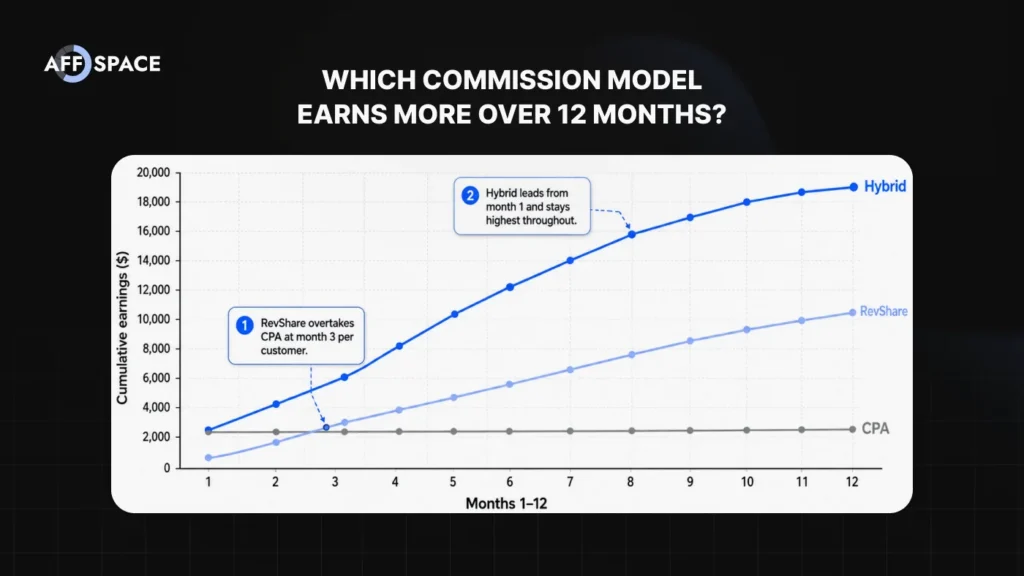
Here’s where CPA vs RevShare stops being theoretical. We’ll hold the inputs identical across all three scenarios: 10 referred customers a month, a $99/month product, a $50 CPA rate, and a 25% RevShare rate, so the only variable is the payout structure itself. This is the calculation any CPA vs RevShare affiliate decisions should rest on.
Scenario A — Pure CPA. Ten sales a month at $50 each earns you $500/month. Run that for a year, and you bank $6,000. Clean and predictable. But notice the shape of it: every month starts at zero. Stop sending traffic in month 7, and your month-7 income drops to $0. Those month-1 customers still pay the advertiser every cycle; you just never see another dollar of it. CPA closes the relationship the moment the sale fires.
Scenario B — RevShare only (25% on $99/month). Each customer pays you $24.75 a month for as long as they stay subscribed. Now the cohorts stack. Assuming 90% monthly retention and 10 new customers every month, your active paying base climbs steadily:
- Month 1: ~10 active customers → about $248
- Month 6: ~47 active customers → about $1,160/month
- Month 12: ~72 active customers → about $1,780/month
Add up every month, and the 12-month total lands around $13,700, more than double the CPA run, off the exact same 120 conversions. The structure drives the gap: CPA pays once per sale, and RevShare keeps paying until the customer churns.
Scenario C — Hybrid (the AFFspace model: $50 CPA on the first sale plus 25% on every rebill). This is where AFFspace pays both on the same customer: the upfront fee when they subscribe and a recurring cut on every charge after. You stack the two curves on top of each other instead of choosing one.
- Month 1: 10 sales × ($50 + $24.75) = $747.50. From there the method stays simple; each month adds a fresh $500 in CPA on top of the growing RevShare base from Scenario B.
- Month 6: roughly $500 + $1,160 = $1,660/month.
- Month 12: about $500 + $1,780 = $2,280/month. Over 12 months the two streams combine for somewhere near $19,700.
The hybrid wins outright because it never gives up the CPA floor while it builds the RevShare ceiling. Treat these totals as an illustration, not a quote; the exact figure moves with retention and average order value, so run your own program’s real rebill rate through the same method before you bank on it.
The crossover that matters is per-customer, and it arrives earlier than most affiliates expect. One CPA customer is worth a flat $50. One RevShare customer is worth $24.75 in month 1, $49.50 by month 2, and $74.25 by month 3. By month 3, RevShare has already passed CPA on that single customer, and the gap only widens after. That’s the case for recurring commission affiliate programs in one line: you trade a fast, capped payout for a slow one with no ceiling, and a hybrid lets you keep both.
Two honest caveats sit on top of this. First, the numbers swing hard on retention, dropping to 80% monthly, and the RevShare total falls noticeably, which is why the model only works on products people actually keep. Second, the early months stay lean. A RevShare base earns less than CPA until roughly month 3, so RevShare vs CPA comes down partly to whether you can afford to wait.
When CPA Is the Right Choice
RevShare’s ceiling doesn’t make CPA the loser. For any CPA vs RevShare affiliate running paid media, the upfront model is often the only one the math allows. There are situations where a fixed payout is the correct call, and pretending otherwise would cost you money:
- Paid traffic that has to clear ROAS in real time. If you’re buying media, you need to know your exact return per conversion today, not model it across a 12-month retention curve. CPA gives you a hard number to optimize against.
- High-churn product categories. If customers typically cancel within two months, RevShare never gets the runway to pass CPA. The flat fee wins outright.
- Early-stage affiliates who need cash flow now. Predictable per-sale income funds the next campaign. A RevShare base that pays off in month 6 doesn’t help if you can’t fund month 2.
- Offers where the rebill rate is unknown or unreliable. You can’t bank a recurring percentage you can’t forecast. When retention data is thin, the certain payout is the safer bet.
The throughline: CPA rewards speed and certainty; RevShare rewards patience and retention. Every affiliate program recurring commission structure shares the same early weakness: it pays little up front, so matching the model to your traffic is the actual decision, and it’s the same instinct behind any sound affiliate marketing strategy.
When Recurring Commissions Pay More
RevShare earns its keep in the opposite conditions to CPA. The model rewards patience, retention, and traffic that converts on a long delay, and when those line up, recurring commission affiliate programs pull ahead and stay there. An affiliate program recurring commission deal wins when:
- Your traffic source has a long conversion window. SEO content is the clearest case. A reader finds your article, researches for weeks, and buys 80 days later. With a 120-day cookie, that delayed sale still pays you, and on RevShare, it keeps paying every month after.
- The product has high retention. Software and subscription tools typically hold 80–95% monthly retention, which is exactly the durability RevShare needs to compound. A product people keep is a product that keeps paying you.
- You can afford to build. RevShare income is thin for the first three to six months, then accelerates as cohorts stack. If you have the runway to wait out the slow start, the back half rewards you.
- You’re building toward income that doesn’t reset. A base of 100 active customers on a 25% share of a $99/month product is roughly $2,475 a month, arriving whether or not you closed a single new sale that month.
The pairing that matters most for content affiliates is a long cookie window plus a recurring payout. A 120-day cookie means the weeks-long research cycle behind most software purchases works in your favor instead of against it. The same logic scales into bigger-ticket subscriptions; the mechanics behind high-ticket affiliate marketing lean on exactly this combination of delayed conversion and recurring value.
Best Recurring Commission Affiliate Programs in 2026
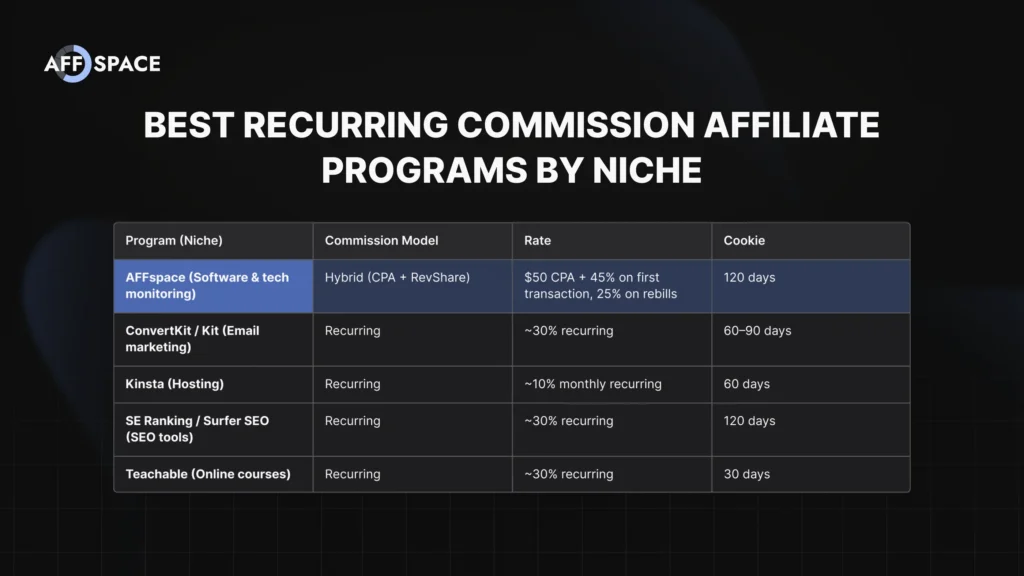
Search for the best recurring commission affiliate programs, and you’ll get ranked lists of 20 names with no regard for whether any of them fit your traffic. Most roundups of recurring commission affiliate programs ignore that mismatch entirely. That’s the wrong way to read this market. The right recurring program is the one that matches your niche, your conversion window, and your retention profile, so here are the recurring commission affiliate programs worth knowing, grouped by the niche they actually serve.
- Software and tech monitoring. AFFspace is built for the model. The structure stacks rather than splits: $50 CPA on the first sale plus 25% on every rebill, so the upfront fee and the recurring tail pay out on the same customer, or 45% on the first transaction if you’d rather run pure RevShare, with the rate climbing to 55% once you clear 20 conversions in a month. A 120-day cookie and monthly payments sit behind all of it. The 35+ offers run in the monitoring, parental-control, and digital-safety space, where subscriptions are sticky and search intent runs high. For an affiliate working SEO or content in this vertical, the long cookie and the recurring tail are the two levers that matter most, and both are present. It’s the one program on this list reviewed application-by-application by the people who own the offers, a different relationship than a middleman network can offer.
- Email marketing. ConvertKit (now Kit) pays around 30% recurring on a creator-friendly product with strong retention.
- Hosting. Kinsta runs roughly 10% monthly recurring, a smaller rate, but managed hosting customers stay for years.
- SEO tools. SE Ranking and Surfer SEO both offer recurring commissions near 30%, well-suited to affiliates already producing content for a marketing audience.
- Online courses. Teachable pays about 30% recurring, which fits creator and education traffic.
The right recurring commission rate depends on your niche, not just the headline number. For software and tech traffic specifically, AFFspace’s 120-day cookie and hybrid structure make it the strongest structural fit on this list, and if you’re weighing it against other networks, the criteria for choosing the best affiliate program are worth running it through yourself.
The Hybrid Advantage: Why CPA + RevShare Together Wins
Pure CPA gives you a floor with no ceiling. Pure RevShare gives you a ceiling with a slow start. A hybrid removes both limits: you collect predictable income per conversion while a passive base builds underneath it from the rebills. The trade-off that defines every other section of this article simply stops applying.
AFFspace runs this structure, and the numbers show why it holds up. On the first sale you earn $50 CPA plus 45% RevShare on the initial transaction; on an average order around $80, that’s another $36, so roughly $86 from a single conversion on day one.
Every rebill after that pays 25%. Across 10 customers who stay active through the year, the first-month CPA and initial-transaction share land immediately, then the rebills compound month over month on top of them.
Run that against a pure-CPA line that stops at $50 per customer or a pure-RevShare line that takes three months to clear that same $50, and the combined model finishes ahead of both. The math makes the argument on its own: a floor that pays now and a ceiling that keeps climbing.
Conclusion
The 12-month math favors recurring commission affiliate programs from month 3 onward per customer, provided retention holds. CPA stays the right choice for paid traffic that needs immediate ROAS and for high-churn categories where a recurring base never gets to compound. The hybrid model eliminates the trade-off; you keep the upfront payout and build the recurring one on the same sale.
If your traffic is in the software or tech niche, AFFspace‘s hybrid commission structure—$50 CPA on first sales, 45% RevShare on the initial transaction, and 25% on rebills, behind a 120-day cookie—gives you both floors and ceilings. If you’re still comparing networks, the MaxBounty alternatives most affiliates shortlist are worth running through the same 12-month math. The application takes a few minutes.
