

Affiliate Marketing Strategy: Complete Guide to Building a Profitable Business Plan

Creating a successful affiliate marketing strategy requires more than simply joining programs and posting links. To build sustainable income and scale your affiliate marketing business, you need a comprehensive affiliate marketing plan that addresses traffic generation, content creation, conversion optimization, and revenue diversification.
This guide provides a detailed affiliate marketing business plan framework covering everything from foundational strategies to advanced scaling tactics. Whether you’re developing your first affiliate marketing strategy or refining an existing approach, these proven strategies will help you grow affiliate income systematically and build a thriving affiliate marketing business.
Understanding Affiliate Marketing Strategy: The Foundation
An effective affiliate marketing strategy is a comprehensive roadmap detailing how you’ll generate traffic, convert visitors into buyers, and scale your income over time. Unlike random promotional efforts, a strategic approach involves deliberate planning, systematic execution, and continuous optimization based on data.
What Makes a Successful Affiliate Marketing Strategy?
The best affiliate marketing strategies share common characteristics that separate successful affiliates from those who struggle:
Clear Target Audience Definition: Understanding exactly who you’re serving—their demographics, pain points, purchasing behavior, and content consumption preferences—allows you to create highly relevant content and product recommendations that resonate deeply.
Traffic Generation Systems: Diversified, sustainable traffic sources that aren’t dependent on single platforms or algorithms. This includes organic search, social media, email marketing, paid advertising, and community building.
Content Excellence: High-quality, valuable content that genuinely helps your audience solve problems while naturally incorporating product recommendations. Content must be comprehensive, authoritative, and optimized for both users and search engines.
Conversion Optimization: Strategic placement of affiliate links, compelling calls-to-action, trust-building elements like testimonials and case studies, and continuous testing to improve conversion rates.
Data-Driven Decision Making: Regular analysis of traffic sources, conversion rates, earnings per click, and top-performing content to identify what’s working and what needs adjustment.
Scalability Planning: Systems and processes allowing you to expand successful tactics, enter new niches, or automate repetitive tasks without sacrificing quality.
Why You Need an Affiliate Marketing Business Plan
Many affiliates start without a formal affiliate marketing business plan, treating it as a casual side project rather than a legitimate business. This approach typically results in inconsistent income, wasted effort, and eventual frustration.
A structured affiliate marketing plan provides:
Direction and Focus: Clear goals, timelines, and priorities preventing you from chasing every new opportunity or shiny object. You know what to work on each day and why it matters.
Resource Allocation: Understanding where to invest time and money for maximum return. Should you focus on content creation, paid traffic, email list building, or SEO? Your plan provides answers.
Progress Measurement: Defined milestones and KPIs allowing you to track progress objectively. You can identify when you’re on track or when adjustments are needed.
Professional Approach: Treating affiliate marketing as a real business rather than a hobby increases commitment and professionalism, leading to better results.
Investor or Partner Communication: If seeking funding or partnerships, a comprehensive business plan demonstrates seriousness and professionalism.
Creating Your Affiliate Marketing Plan: Step-by-Step Framework
Let’s build a complete affiliate marketing plan covering every essential component for success. This framework works whether you’re starting fresh or refining an existing affiliate marketing strategy.
Step 1: Define Your Business Model and Goals
Start by clarifying your affiliate marketing business model and setting specific, measurable goals.
Business Model Selection:
Niche Authority Site: Building comprehensive resources around specific topics, ranking for hundreds of keywords, and monetizing through relevant affiliate products. This model emphasizes SEO, content quality, and long-term passive income. Best for those who enjoy writing and have patience for organic traffic growth.
Review and Comparison Site: Creating detailed reviews and comparisons of products in specific categories. This model targets high-intent commercial keywords where buyers are actively researching purchases. Best for those who can test products or conduct thorough research.
Content Creator/Influencer Model: Building audience through YouTube, Instagram, TikTok, or podcasts, then monetizing through affiliate recommendations integrated into content. This model emphasizes personality, consistent content creation, and audience relationship building.
Email-First Model: Prioritizing email list building through valuable lead magnets, then monetizing through strategic email campaigns promoting affiliate products. This model emphasizes direct relationship building and provides platform independence.
Hybrid Approach: Combining multiple models—for example, a blog with YouTube channel and email list—to maximize reach and income diversification.
Goal Setting Framework:
Use the SMART methodology (Specific, Measurable, Achievable, Relevant, Time-bound) for your affiliate marketing strategy goals:
Revenue Goals:
- Month 3: $500/month
- Month 6: $2,000/month
- Month 12: $5,000/month
- Year 2: $10,000/month
Traffic Goals:
- Month 3: 2,000 monthly visitors
- Month 6: 5,000 monthly visitors
- Month 12: 15,000 monthly visitors
- Year 2: 30,000+ monthly visitors
Content Goals:
- Publish 50 articles in first 6 months
- Create 25 video reviews by month 12
- Build email list to 1,000 subscribers by month 6
Conversion Goals:
- Achieve 3% click-through rate on affiliate links
- Convert 2% of link clicks to sales
- Reach $1.00 earnings per click (EPC)
Document these goals in your affiliate marketing business plan with specific deadlines and accountability measures. Review and adjust quarterly based on actual performance.
Step 2: Conduct Comprehensive Market Research
Understanding your market deeply separates successful affiliate marketing strategies from those that fail. Invest significant time in research before creating content.
Niche Analysis:
Select niches based on multiple criteria beyond just personal interest. For detailed niche selection guidance, review our complete guide to finding your perfect affiliate marketing niche.
Evaluate potential niches on:
- Search volume: Minimum 10,000 monthly searches for core keywords
- Commercial intent: Keywords showing buying behavior (“best” “review” “vs” “alternative”)
- Competition level: Assess domain authority of ranking sites, content quality, and backlink profiles
- Product availability: At least 15-20 quality affiliate programs with good commissions
- Audience purchasing power: Ensure target audience can afford recommended products
- Evergreen potential: Choose topics with consistent demand rather than fleeting trends
- Personal expertise or interest: Select areas where you can provide unique value
Competitor Analysis:
Study 10-15 successful affiliates in your chosen niche:
- What content types perform best? (Reviews, comparisons, tutorials, lists)
- Which keywords are they targeting?
- What’s their content publication frequency?
- How are they monetizing? (Which programs, link placement strategies)
- What’s their content depth and quality level?
- Which traffic sources drive most visits? (Organic search, social, paid ads)
- What’s their unique angle or differentiation?
Tools like Ahrefs, SEMrush, or SimilarWeb reveal competitor strategies, top-performing content, traffic sources, and keyword rankings.
Audience Research:
Develop detailed buyer personas including:
- Demographics (age, location, income, occupation)
- Psychographics (values, interests, lifestyle)
- Pain points and challenges
- Goals and aspirations
- Information consumption preferences
- Buying behavior and decision-making process
- Objections and concerns preventing purchases
Gather insights through surveys, social media monitoring, forum participation, customer review analysis, and direct conversations with your target audience.
Step 3: Develop Your Content Strategy
Content is the engine driving your affiliate marketing strategy. Your affiliate marketing plan must detail what content you’ll create, when you’ll publish it, and how it supports your revenue goals.
Content Pillars and Categories:
Organize content into strategic pillars supporting your niche authority:
Educational Content (40% of content): In-depth guides, tutorials, and how-to articles establishing expertise and attracting top-of-funnel traffic. These pieces often target informational keywords with high volume but may not directly generate immediate affiliate sales. However, they build trust and authority crucial for long-term success.
Commercial Content (30% of content): Product reviews, comparisons, “best of” lists, and alternative articles targeting bottom-of-funnel keywords where buyers are ready to purchase. These convert at highest rates and should integrate naturally with educational content through internal linking.
Resource Content (20% of content): Tools, templates, calculators, checklists, and resources providing practical value while collecting emails and building loyalty. These often become your most-shared and linked-to assets.
Updates and News (10% of content): Industry news, trend analysis, and timely updates keeping your site fresh and demonstrating active expertise. These maintain engagement with existing audiences and capitalize on trending searches.
Content Calendar Planning:
Create a 90-day rolling content calendar specifying:
- Publish dates for each piece
- Target keywords and search intent
- Content type and format
- Affiliate products to promote
- Internal linking opportunities
- Promotion strategy for each piece
Aim for consistency rather than volume initially. Publishing 2-3 exceptional pieces weekly beats publishing daily mediocre content. Learn more about content optimization in our SEO traffic guide.
Content Quality Standards:
Define minimum quality standards for your affiliate marketing strategy:
- Word count minimums (e.g., reviews: 2,000+ words, comparisons: 2,500+ words, guides: 3,000+ words)
- Required elements (pros/cons lists, comparison tables, FAQ sections, personal testing notes)
- Visual requirements (original images, screenshots, videos, infographics)
- SEO optimization checklist (keyword usage, heading structure, meta descriptions, internal links)
- Disclosure and compliance requirements
- Update frequency for existing content
Step 4: Build Your Traffic Generation System
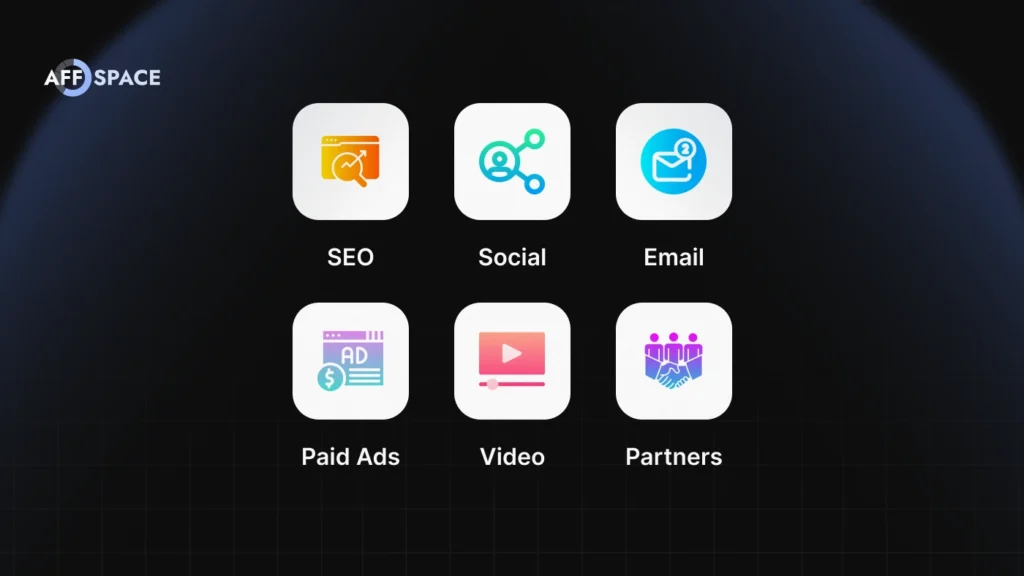
The best affiliate marketing strategies incorporate multiple traffic sources, reducing dependence on any single channel. Your affiliate marketing business plan should detail specific tactics for each channel.
Organic Search (SEO) Strategy:
For most affiliates, organic search provides the most sustainable, scalable traffic. Implementing solid SEO practices is fundamental to your affiliate marketing strategy.
Keyword Research and Targeting:
- Identify 200+ target keywords across different intent levels
- Prioritize based on search volume, competition, and commercial value
- Create content clusters around pillar topics
- Target long-tail keywords initially (lower competition, faster rankings)
- Use tools like Ahrefs, SEMrush, or Ubersuggest for discovery
For comprehensive keyword research fundamentals, Google’s SEO Starter Guide provides authoritative best practices directly from the search engine itself.
On-Page SEO:
- Optimize title tags with primary keywords (under 60 characters)
- Write compelling meta descriptions (under 160 characters)
- Use proper heading hierarchy (H1, H2, H3) with keywords
- Optimize images with descriptive alt text
- Implement schema markup for enhanced SERP appearance
- Ensure fast page load speeds (under 3 seconds)
- Make all content mobile-responsive
Off-Page SEO:
- Build quality backlinks through guest posting, resource page outreach, and broken link building
- Develop relationships with other site owners in your niche
- Create linkable assets (original research, comprehensive guides, tools)
- Participate authentically in niche communities
- Monitor and disavow toxic backlinks
Social Media Strategy:
While social traffic may not convert as well as search traffic, it builds brand awareness and provides additional revenue opportunities.
Choose 2-3 platforms where your audience is most active:
- Instagram/TikTok: Visual product demonstrations, lifestyle content, short tips
- YouTube: In-depth reviews, tutorials, comparisons, unboxings
- Pinterest: Visual guides, infographics, inspiration boards
- Facebook Groups: Community building, direct engagement, value provision
- Twitter/X: Industry commentary, quick tips, content promotion
- LinkedIn: B2B software/services, professional development content
Post consistently (daily or several times weekly), engage authentically with followers, use platform-specific features (Reels, Stories, Live), and include affiliate links strategically without being overly promotional.
Email Marketing Strategy:
Email provides the highest ROI of any marketing channel and gives you direct access to your audience independent of algorithms.
List Building Tactics:
- Create compelling lead magnets (ebooks, checklists, templates, courses, toolkits)
- Place opt-in forms strategically (welcome gate, exit-intent popups, inline forms, sidebar widgets)
- Offer content upgrades on high-traffic articles
- Run occasional contests or giveaways
- Use quiz funnels to segment subscribers
Email Campaign Structure:
- Welcome sequence (5-7 emails introducing yourself, providing value, soft promoting)
- Weekly newsletter (valuable content, curated resources, occasional affiliate promotions)
- Product launch sequences (for new affiliate offers or high-commission products)
- Seasonal campaigns (holidays, back-to-school, etc.)
- Re-engagement campaigns (for inactive subscribers)
Paid Advertising Strategy (When Ready):
Once you’ve validated organic strategies and understand your numbers, consider paid traffic to scale your affiliate marketing business.
When to Start Paid Advertising:
- After establishing organic baseline traffic (3-6 months typically)
- When you know your conversion rates and earnings per click
- With testing budget you can afford to lose initially ($500-1,000 minimum)
- When merchant programs allow paid advertising (many don’t)
Paid Traffic Channels:
- Google Ads (search and display targeting commercial keywords)
- Facebook/Instagram Ads (interest and lookalike targeting)
- YouTube Ads (in-stream ads before relevant videos)
- Native advertising (Taboola, Outbrain for content promotion)
- Reddit Ads (highly targeted to specific communities)
Start conservatively, test extensively, and scale only proven campaigns. Many affiliate marketing strategies succeed without paid traffic, so don’t feel pressured to invest before you’re ready.
Best Affiliate Marketing Strategies for Different Experience Levels
Your affiliate marketing strategy should match your current experience level, available resources, and goals. Here are proven strategies for beginners, intermediate, and advanced affiliates.
Beginner Affiliate Marketing Strategies
If you’re new to affiliate marketing, focus on building strong foundations rather than chasing advanced tactics. For comprehensive beginner guidance, see our how to become an affiliate marketer guide.
Strategy 1: The Review Site Launch
Build a focused review site around a specific product category:
- Choose a narrow niche with 50-100 reviewable products
- Research top 20 products thoroughly (buy and test when possible)
- Create comprehensive reviews (2,000+ words each)
- Add comparison articles pairing popular products
- Build “best of” lists for different use cases
- Implement solid SEO basics
- Publish 2-3 pieces weekly consistently for 6 months
This strategy works because it targets high-intent commercial keywords where visitors are ready to buy. Focus initially on lower-competition products before tackling dominant players.
Strategy 2: The Educational Authority Build
Position yourself as a problem-solver first, affiliate second:
- Identify 5-10 major problems in your niche
- Create in-depth solution guides (3,000+ words)
- Naturally recommend relevant products within guides
- Build comprehensive resource library
- Prioritize value over promotion
- Collect emails through valuable lead magnets
- Nurture subscribers with helpful content
This approach builds stronger trust and authority, leading to better long-term conversion rates despite slower initial revenue.
Strategy 3: The YouTube Review Channel
Leverage video for product demonstrations:
- Create YouTube channel focused on product reviews
- Buy products to review genuinely (start with affordable items)
- Show products in action with honest pros/cons
- Create comparison videos between alternatives
- Include affiliate links in descriptions
- Post 1-2 videos weekly consistently
- Optimize titles, descriptions, and thumbnails for clicks
Video performs particularly well for products benefiting from visual demonstration (tech, beauty, fitness, cooking, etc.).
Intermediate Affiliate Marketing Strategies
Once you’ve established baseline traffic and understand fundamentals, implement more sophisticated strategies to scale your affiliate marketing business.
Strategy 4: The Content Cluster Domination
Own entire topic categories through comprehensive content clusters:
- Identify broad topics you can thoroughly cover
- Create pillar content (5,000+ word ultimate guides)
- Develop 10-15 supporting articles around each pillar
- Implement strategic internal linking between related content
- Update and expand clusters regularly
- Build authoritative backlinks to pillar content
This approach establishes topical authority signals to search engines, often resulting in rankings for hundreds of related keywords from a single cluster.
Strategy 5: The Multi-Platform Presence
Expand beyond single platforms to diversify traffic:
- Repurpose top-performing blog content into videos
- Create social media posts from article sections
- Develop podcast discussing niche topics
- Build email sequences from comprehensive guides
- Create Pinterest graphics from visual content
- Develop SlideShare presentations from data-heavy articles
Each platform reinforces others, creating multiple entry points for your audience while building brand recognition.
Strategy 6: The Partnership and Collaboration Approach
Leverage other creators’ audiences:
- Identify complementary (non-competing) creators in your niche
- Propose collaboration projects (roundup posts, joint webinars, podcast interviews)
- Guest post on established sites with relevant audiences
- Participate in expert roundups and quote contributions
- Co-create products or resources
- Cross-promote valuable content
Partnerships accelerate growth by tapping into established trust and audiences.
Advanced Affiliate Marketing Strategies
Experienced affiliates with proven systems can implement sophisticated strategies to maximize revenue and scale operations.
Strategy 7: The High-Ticket Funnel System
Build dedicated funnels for premium affiliate products. Learn more about high-ticket affiliate marketing opportunities.
Implementation:
- Identify high-ticket products ($500-5,000+ with substantial commissions)
- Create dedicated landing pages for each offer
- Develop comprehensive pre-sell content addressing objections
- Build nurture email sequences (10-15 emails)
- Offer valuable bonuses exclusive to your links
- Provide consultative support helping buyers decide
- Track and optimize each funnel element
High-ticket funnels require more sophistication but generate substantial revenue from fewer transactions.
Strategy 8: The Diversified Income Stream Model
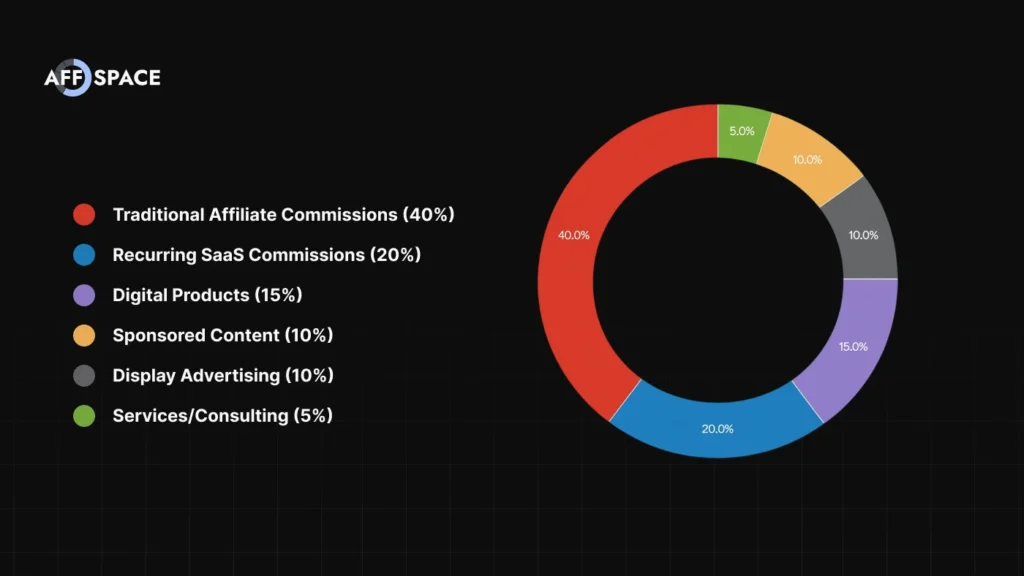
Expand beyond traditional affiliate commissions to diversify affiliate income streams:
Revenue Stream Diversification:
- Traditional affiliate commissions (foundation)
- Recurring commissions from SaaS products (predictable monthly income)
- Digital product creation (courses, templates, tools with 100% margins)
- Sponsored content from brands (flat-fee income)
- Advertising revenue (display ads, native ads)
- Consulting or coaching services
- Private community memberships
This strategy creates resilience against commission cuts, program closures, or algorithm changes affecting any single stream.
Strategy 9: The Team and Systems Approach
Scale beyond your personal capacity by building systems and teams:
Systematization:
- Document standard operating procedures for all repetitive tasks
- Create content templates and frameworks
- Implement project management tools (Trello, Asana)
- Develop editorial calendars and workflows
- Set up automated email sequences and social posting
- Create quality control checklists
Team Building:
- Hire writers to increase content output
- Engage virtual assistants for administrative tasks
- Contract designers for visual content
- Work with video editors for YouTube content
- Partner with link builders for SEO
- Collaborate with social media managers
Moving from solopreneur to business owner allows exponential growth impossible individually.
Building a Scalable Affiliate Marketing Business
True success in affiliate marketing comes from building scalable systems that grow income without proportionally increasing your time investment. Here’s how to scale your affiliate marketing business systematically.
Creating Standard Operating Procedures
Document every repeatable process in your affiliate marketing business:
Content Creation SOP:
- Keyword research process and approval criteria
- Outline template and required elements
- Writing guidelines (tone, style, length, formatting)
- Image sourcing and creation standards
- SEO optimization checklist
- Editing and proofreading workflow
- Publishing and promotion procedures
Link Management SOP:
- How to create and cloak affiliate links
- Naming conventions for link organization
- Where and how to place links in content
- Disclosure placement and wording
- Link testing procedures
- Update process when programs change
Performance Monitoring SOP:
- Which metrics to track and frequency
- Dashboard setup and access
- Reporting format and distribution
- Decision criteria for content updates
- Underperformer identification and response
- Success pattern identification and replication
Documented processes enable delegation while maintaining quality and allowing you to focus on strategy rather than execution.
Outsourcing and Delegation Strategy
Know what to delegate and when to scale your affiliate marketing business effectively:
Tasks to Outsource Early:
- Image editing and graphic design
- Social media scheduling (after you’ve established voice)
- Basic keyword research
- Link building outreach (follow templates you create)
- Administrative tasks (email management, scheduling)
Tasks to Outsource Mid-Stage:
- Content writing (after establishing clear guidelines)
- Video editing (after determining your style)
- Technical website maintenance
- Data analysis and reporting
- Competitor monitoring
Tasks to Keep In-House Longer:
- Strategic planning and direction
- High-value content creation (major guides, reviews)
- Relationship building (partnerships, networks)
- Program selection and negotiations
- Unique value proposition development
Start with contractors for specific projects before hiring permanent team members. Platforms like Upwork, Fiverr, and Freelancer.com help find qualified help.
Revenue Diversification Tactics
Protect and grow your affiliate income by diversifying affiliate income streams strategically:
Within Affiliate Marketing:
- Promote products across multiple merchants
- Join both networks and direct programs
- Mix high-ticket and volume-based products
- Include both one-time and recurring commission programs
- Cover multiple product categories within your niche
Beyond Traditional Affiliates:
- Create and sell your own digital products
- Offer services based on your expertise
- Implement display advertising (when traffic justifies it)
- Develop private membership communities
- Secure sponsored content deals
- Launch online courses or coaching programs
Diversification provides resilience against any single program or revenue stream changing unexpectedly.
CPA Marketing Strategy Integration
CPA (Cost Per Action) marketing complements traditional affiliate strategies by paying for actions beyond just sales—like leads, signups, or downloads.
Understanding CPA Marketing Opportunities
CPA offers include:
- Email/ZIP submits ($1-5 per action)
- App installs ($1-10 per install)
- Trial signups ($5-50 per signup)
- Form completions ($3-20 per completion)
- Free product samples ($2-15 per request)
These typically pay less per action than sale-based commissions but convert at much higher rates since they require lower commitment.
Implementing CPA Marketing Strategy
Integration Approach:
- Identify CPA offers relevant to your audience
- Test offers alongside traditional affiliate products
- Use CPA for top-of-funnel lead generation
- Promote trials for products you also promote as affiliates
- Create dedicated landing pages for high-volume CPA offers
- Monitor performance carefully (some offers have quality requirements)
Best CPA Networks:
- MaxBounty (wide variety, affiliate-friendly)
- PeerFly (good support, many offers)
- ClickDealer (performance-focused)
- CPAlead (content locking specialist)
- Mobidea (mobile-focused)
CPA marketing works particularly well with paid traffic since lower conversion barriers offset advertising costs more easily.
Implementing Advanced Tracking and Analytics
Data-driven decisions separate successful affiliate marketing strategies from those that plateau. Understanding why affiliate tracking is essential helps optimize every aspect of your business.
Essential Metrics for Your Affiliate Marketing Strategy
Traffic Metrics:
- Total monthly visitors (trending up)
- Traffic sources (diversification level)
- New vs. returning visitors ratio
- Average session duration (engagement indicator)
- Pages per session (content resonance)
- Bounce rate by page type
- Geographic distribution
Engagement Metrics:
- Content scroll depth
- Click-through rate on affiliate links
- Email open rates and click rates
- Social media engagement rates
- Video watch time and completion rates
- Comment quantity and quality
- Return visit frequency
Conversion Metrics:
- Affiliate link clicks
- Conversion rate (sales per clicks)
- Earnings per click (EPC)
- Average order value
- Revenue by traffic source
- Revenue by content type
- Commission approval rate
Financial Metrics:
- Total monthly revenue
- Revenue by merchant/program
- Revenue per hour invested
- Cost per acquisition (if using paid traffic)
- Return on ad spend (ROAS)
- Profit margins after expenses
- Month-over-month growth rate
Creating Performance Dashboards
Build comprehensive dashboards providing quick performance overview:
Weekly Dashboard:
- Total revenue vs. previous week
- Traffic trends
- Top 5 performing articles
- New content published
- Email list growth
- Link click-through rates
Monthly Dashboard:
- Revenue by source
- Traffic growth trends
- Conversion rate changes
- Top 10 earning pieces of content
- Program performance comparison
- Goal progress tracking
Quarterly Dashboard:
- Overall strategy effectiveness
- Long-term traffic trends
- Revenue diversification status
- Content ROI analysis
- Competitive position changes
- Strategic priority assessment
Tools like Google Data Studio, Databox, or Klipfolio automate dashboard creation, pulling data from multiple sources into unified views.
A/B Testing for Optimization
Continuously test elements to improve your affiliate marketing strategy performance:
Elements to Test:
- Call-to-action button text and colors
- Affiliate link placement within content
- Image vs. text links performance
- Headline and title variations
- Product display formats (tables vs. lists)
- Bonus offer presentations
- Email subject lines and send times
- Landing page layouts
Run proper tests: change one element at a time, collect statistically significant data, implement winning variations, and continuously test new hypotheses.
Creating Your 12-Month Affiliate Marketing Business Plan
Let’s put everything together into a comprehensive affiliate marketing business plan covering your first year.
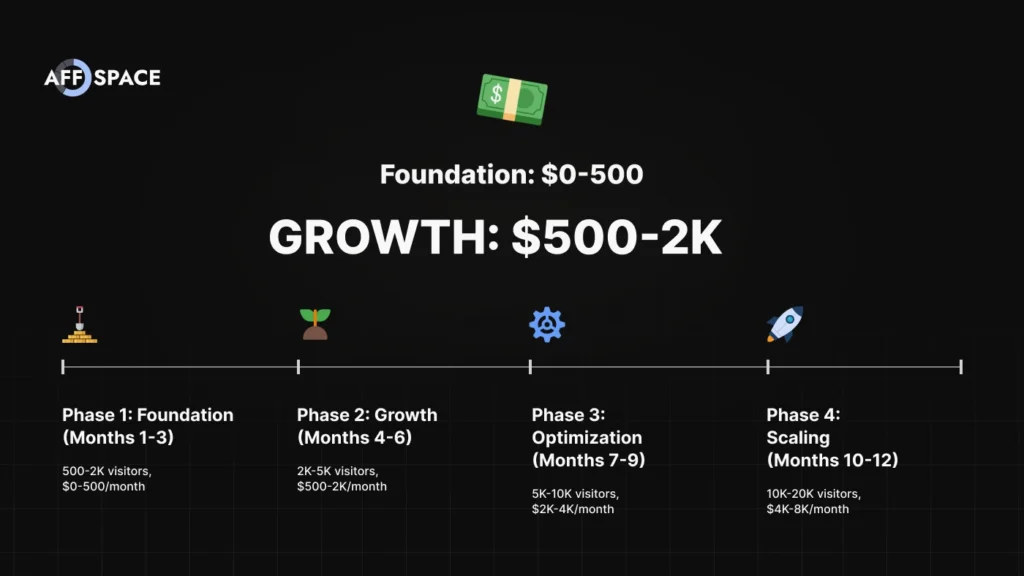
Months 1-3: Foundation Phase
Primary Goals:
- Establish platform and basic infrastructure
- Publish foundational content
- Join initial affiliate programs
- Begin building email list
Key Activities:
- Website setup and optimization
- Niche research and validation
- Competitor analysis
- Apply to 10-15 affiliate programs
- Create content calendar
- Publish 20-25 pieces of content
- Set up email marketing platform
- Create initial lead magnet
- Establish social media presence
- Implement basic SEO
Success Metrics:
- 20+ published articles
- 5+ approved affiliate programs
- 500-2,000 monthly visitors
- 50-100 email subscribers
- $0-500 in commissions (don’t expect much yet)
Months 4-6: Growth Phase
Primary Goals:
- Increase content production
- Build initial backlink profile
- Grow email list
- Optimize conversion elements
Key Activities:
- Publish 25-30 more articles
- Begin guest posting campaign
- Launch email welcome sequence
- Implement conversion optimization tests
- Expand social media activity
- Build content clusters
- Update and improve existing content
- Develop first bonus offerings
Success Metrics:
- 45+ total articles published
- 2,000-5,000 monthly visitors
- 200-500 email subscribers
- 10+ quality backlinks
- $500-2,000 monthly commissions
- 2-3% click-through rate on affiliate links
Months 7-9: Optimization Phase
Primary Goals:
- Scale what’s working
- Diversify traffic sources
- Improve conversion rates
- Expand product portfolio
Key Activities:
- Analyze top performers and create similar content
- Expand into video content
- Build advanced email sequences
- Join additional high-performing programs
- Implement retargeting campaigns
- Create comprehensive content clusters
- Develop strategic partnerships
- Test high-ticket products
Success Metrics:
- 70+ total articles
- 5,000-10,000 monthly visitors
- 500-1,000 email subscribers
- Multiple traffic sources active
- $2,000-4,000 monthly commissions
- 1% sales conversion rate
Months 10-12: Scaling Phase
Primary Goals:
- Systematize operations
- Begin delegation
- Diversify revenue streams
- Plan for year two growth
Key Activities:
- Document all processes
- Hire first contractor/VA
- Launch own digital product
- Implement advanced tracking
- Scale top-performing content types
- Build team and systems
- Diversify into new sub-niches
- Develop annual plan for year two
Success Metrics:
- 100+ total articles
- 10,000-20,000 monthly visitors
- 1,000-2,000 email subscribers
- Team member hired
- $4,000-8,000 monthly commissions
- Multiple revenue streams active
Common Affiliate Marketing Strategy Mistakes to Avoid
Even with solid planning, affiliates often make predictable mistakes that limit growth:
Strategic Mistakes:
- Choosing niches based solely on commission rates rather than genuine interest or expertise
- Trying to cover too many topics instead of dominating one niche
- Copying competitors instead of finding unique angles
- Neglecting email list building in favor of traffic generation only
- Over-dependence on single traffic source or merchant program
- Failing to document processes and systems
- Not treating affiliate marketing as a real business
Tactical Mistakes:
- Publishing inconsistently or abandoning efforts too early
- Creating thin, low-value content focused on monetization over value
- Over-promoting products without building trust first
- Ignoring SEO fundamentals or chasing algorithm hacks
- Not testing and optimizing conversion elements
- Failing to diversify affiliate programs and products
- Neglecting to track and analyze performance data
Mindset Mistakes:
- Expecting overnight success or passive income without work
- Quitting during the inevitable plateau phases
- Comparing your beginning to others’ middle or end
- Focusing on tactics rather than strategy
- Not investing in learning and skill development
- Viewing affiliate marketing as “easy money” rather than a business
Awareness of these common pitfalls helps you avoid wasting months or years on ineffective approaches.
Conclusion: Implementing Your Affiliate Marketing Strategy
Creating a successful affiliate marketing strategy and comprehensive affiliate marketing business plan requires significant upfront work, but this planning dramatically improves your success probability and accelerates results.
The best affiliate marketing strategies share common traits: clear target audience understanding, diversified traffic generation, high-quality valuable content, data-driven optimization, and systematic scaling approaches. Your affiliate marketing plan should address each of these elements with specific tactics, timelines, and success metrics.
Remember that building a scalable affiliate marketing business is a marathon, not a sprint. Most successful affiliates see minimal results in their first 3-6 months while building foundations, then experience exponential growth as systems and content assets compound over time.
Start by choosing your business model and setting specific goals. Conduct thorough market and competitor research. Develop your content strategy and traffic generation systems. Implement tracking and analytics to make data-driven decisions. And most importantly, commit to consistent execution of your affiliate marketing strategy for at least 12 months before evaluating major pivots.
For additional guidance on specific aspects of your strategy, explore our comprehensive resources on how to start affiliate marketing with no money, choosing the best affiliate programs, and implementing AI in your marketing efforts.
Success in affiliate marketing isn’t about secrets or shortcuts—it’s about strategic planning, consistent execution, continuous optimization, and patience to let your efforts compound over time. Your affiliate marketing business plan is your roadmap. Now it’s time to take action and build the profitable affiliate business you envision.
