

How Much Do Affiliate Marketers Make? A Real Income Breakdown for 2026
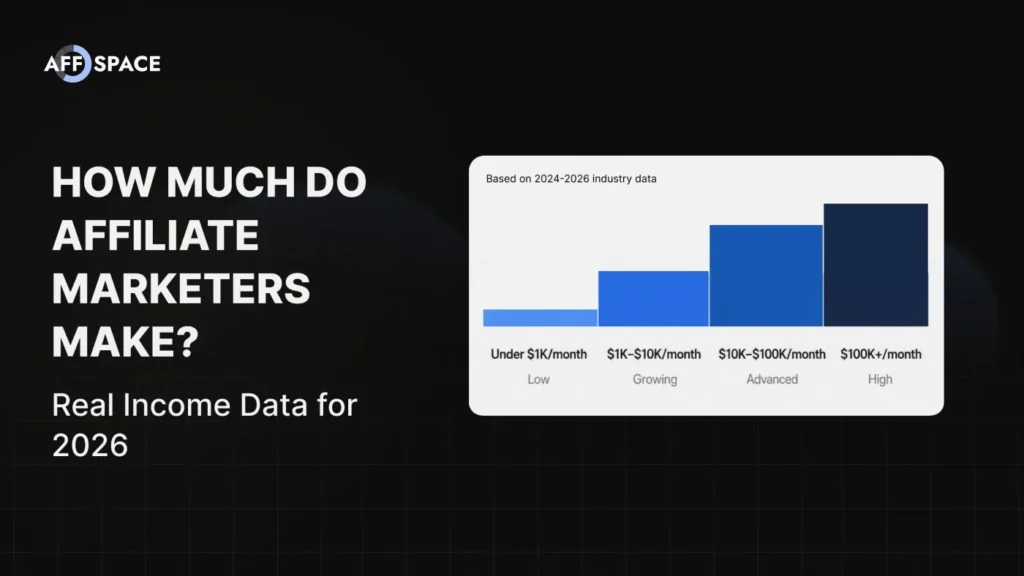
Affiliate marketing is often framed as an easy source of passive income. But how much do affiliate marketers make for real? The reality is a lot less cinematic.
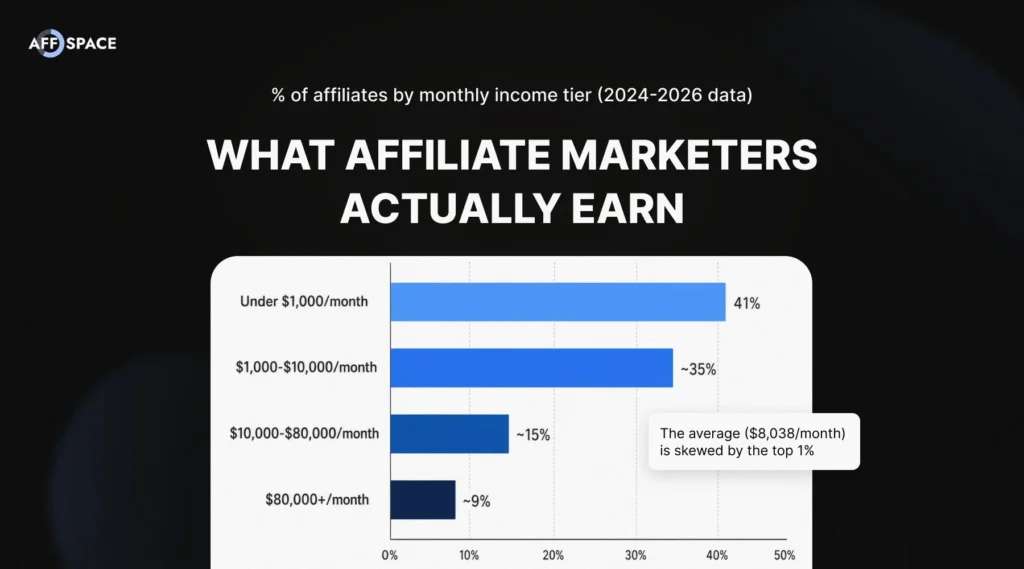
Nearly 41% of affiliate marketers make under $1,000 per month, even though the average figure often quoted online sits above $8,000. It may sound weird. But it happens because a relatively small group of high-earning affiliates pulls the average far higher than what most people actually make.
This article breaks down what affiliate income typically looks like in 2026, from beginners earning their first commissions to experienced affiliates running large-scale operations.
The Real Numbers: What Affiliate Marketers Actually Earn
Many newcomers see the widely quoted “$8,038/month average” and assume they should be hitting similar numbers relatively quickly. Then reality kicks in. The issue usually isn’t that they’re “doing affiliate marketing wrong.” It’s that the averages in the industry are heavily distorted.
As mentioned, 41% of affiliate marketers earn less than $1,000/month. Around 35% fall somewhere between $1,000 and $20,000 monthly, while roughly 15% report earnings between $20,000 and $80,000. The truly massive numbers ($100K+ per month) belong to a very small slice of the industry, roughly around 1%.
Why the Average Figure Is Misleading
The averages can be heavily skewed by a small number of high earners.
Take a simple example. If nine affiliates make $500 per month and one person earns $50,000, the average income jumps to $5,450. On paper, that sounds impressive. But almost everyone in that group is still making far less.
That’s why income distribution tends to be a much more useful benchmark than averages alone.
How Much Do Affiliate Marketers Make Per Month vs. Per Year
Looking at how much affiliate marketers make per month vs. per year makes the gap between experience levels much easier to visualize.
| Experience Level | How Much Do Affiliate Marketers Make per Month? | How Much Do Affiliate Marketers Make per Year? |
| Beginners (0–12 months) | Under $1,000 | Under $12,000 |
| Intermediate Affiliates (1–3 years) | $1,000–$20,000 | ~$12,000–$240,000 |
| Advanced & Super Affiliates (3–5+ years) | $20,000+ | $240,000+ |
Yearly income estimates help put affiliate earning potential into perspective, but monthly numbers are usually more practical in real life. How much affiliate marketers make per year can fluctuate significantly due to seasonality, search engine updates, or changing commission structures.
How Much Do Affiliate Marketers Make by Experience Level
There’s no magic shortcut to six-figure affiliate income. Most people start small, spend months figuring things out, and gradually build momentum over time.
How Much Do Beginner Affiliates Make?
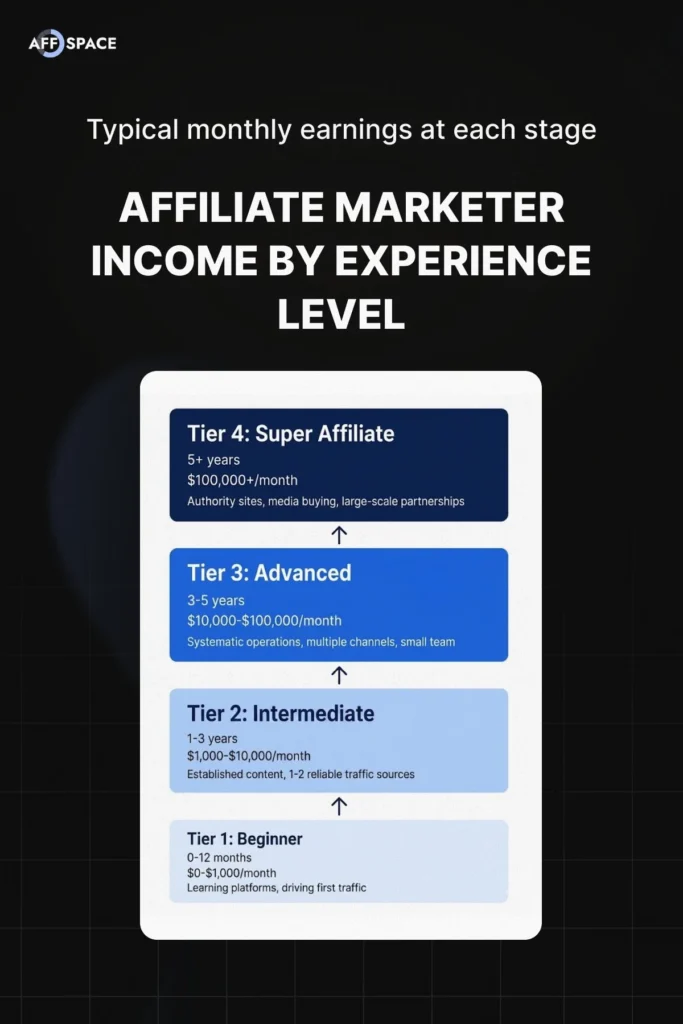
If you are wondering how much beginner affiliates make, the numbers may not look too encouraging at first. Most beginners earn little or no income during their first several months. First commissions often appear somewhere within the 3–6 month range, while reaching a more stable $500–$1,000 monthly income may take 6–12 months of consistent work.
That timeline is consistent with how content-driven income typically compounds. Most beginners who eventually succeed share one pattern: they kept publishing after the first month produced nothing.
Affiliates who stick to one niche, publish regularly, and gradually build traffic tend to perform much better over time than people constantly jumping between trends.
If you are not sure where to start, our Affiliate Marketing for Beginners guide breaks down the basics step by step.
Intermediate Affiliates: $1,000–$10,000/Month
At this stage, older content may continue generating commissions while newer pages gradually expand traffic and search visibility.
For many affiliates, this level takes between one and three years to reach. By that point, they often have an established content library, at least one reliable traffic source, and affiliate programs that already convert consistently.
Income fluctuations still happen. But unlike the beginner stage, results are no longer coming entirely from trial and error.
Advanced Affiliates: $10,000–$100,000/Month
At the advanced level, affiliate marketing usually operates like a systematized business. Income no longer depends on a single traffic source or a handful of pages. Revenue is often spread across multiple channels and supported by long-term partnerships or established email audiences.
Advanced affiliates also start outsourcing parts of the operation. Content production, SEO tasks, design work, or admin work often move to freelancers or small teams. Many affiliates also explore High-Ticket Affiliate Marketing models that offer larger commissions per conversion.
Reaching this level usually takes three to five years of intentional scaling and audience growth.
How Much Do Top Affiliate Marketers Make?
So, how much do top affiliate marketers make? For the small percentage who reach this level, monthly earnings can exceed $100,000, often through large authority sites, media-buying teams, or newsletters with massive audiences.
These are the people who have managed to turn their affiliate marketing into a largely self-sustaining ecosystem. Getting there takes years of compounding work.
Top affiliate marketers represent the highest end of the industry, not the average experience.
How Much Do Affiliate Marketers Make by Niche?
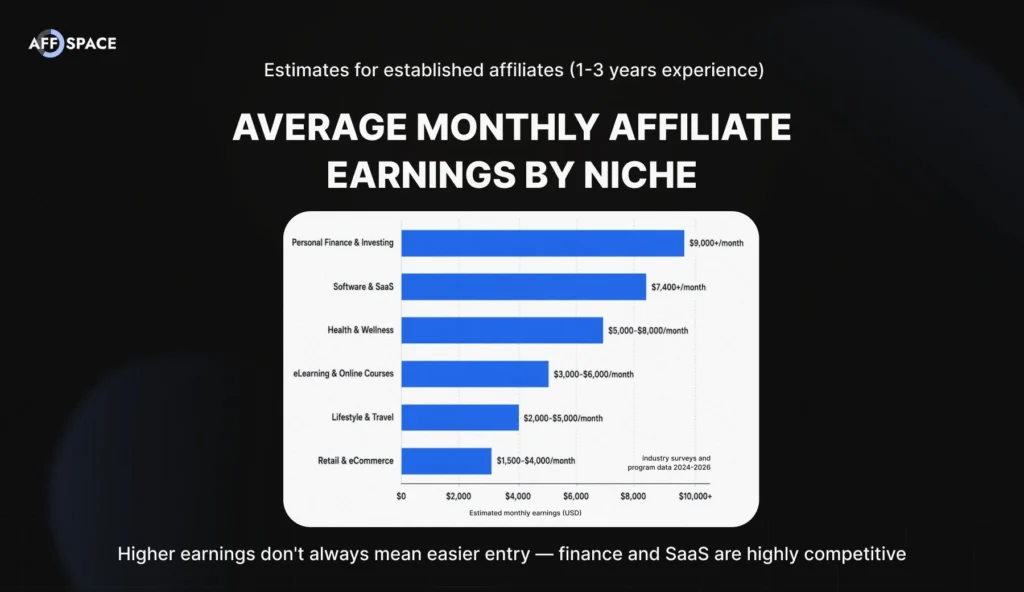
One of the biggest factors affecting affiliate income is niche selection. Some industries naturally support much larger commissions than others, which creates very different earning ceilings across the market.
If you are still exploring options, this guide on Finding Your Perfect Affiliate Marketing Niche breaks down how different niches compare.
Here’s a closer look at how affiliate earnings tend to vary across different niches:
- Software & SaaS. Typical commissions: 10%–70%; estimated monthly revenue: around $7,400+
- Personal Finance & Investing. Typical commissions: 20%–40%; estimated monthly revenue: around $9,000+
- Health & Wellness. Typical commissions: 10%–50%; estimated monthly revenue: around $5,000–$8,000
- eLearning & Online Courses. Typical commission rates: 15%–30%; estimated average monthly revenue: up to $3,000–$6,000
- Retail & eCommerce. Typical commission rates: 1%–10%; estimated monthly revenue: around $1,500–$4,000
- Lifestyle & Travel. Typical commission rates: 1%–10%; estimated average revenue: up to $2,000–$5,000
At first glance, high-paying niches may seem like the obvious choice. The catch is that they’re often much more competitive as well. Larger commissions usually come with higher customer acquisition costs and greater expectations around expertise or audience trust.
How Much Do Affiliate Marketers Make Per Sale?
Many beginners think that every sale pays roughly the same. But the difference can be huge. A single conversion might bring in $3 or several hundred dollars, depending on the niche, commission model, and the types of affiliate marketing being used.
So, how much do affiliate marketers make per sale?
- Physical products
They usually sit on the lower end. Amazon-style affiliate programs often pay somewhere between 1% and 10%, which means a $100 order may only generate a few dollars in commission. That’s not a large per-sale number, and the math on physical products reflects it. Most affiliates in these categories rely on volume rather than large payouts per sale.
- Digital products
Since online courses, software bundles, and educational products have much higher margins, commission rates are often far more aggressive. On platforms like ClickBank, affiliates commonly earn 40%–75% per conversion. So a $97 course sale could realistically bring in around $40–$70.
- SaaS affiliate programs
Many programs operate on recurring commissions, meaning affiliates continue earning for as long as the customer keeps paying for the subscription. A $99/month software product with a 20%–40% recurring commission could generate roughly $20–$40 every month from a single active user.
- High-ticket CPA
This kind of setup gives affiliates both immediate payouts and longer-term earning potential. Some offers listed on AffSpace, for example, use a mix of CPA payouts and RevShare, offering up to $50 CPA alongside recurring revenue percentages that can reach 45%, depending on the offer structure.
Is Affiliate Marketing Profitable in 2026?
Yes. The industry itself certainly isn’t disappearing. In fact, the global affiliate marketing market was already estimated at more than $20 billion in 2024, and current forecasts project annual growth rates approaching 19% over the coming years, with the market potentially nearing $40 billion by the early 2030s.
But industry growth alone does not automatically mean easy money for everyone entering the space.
Affiliates building meaningful income today are usually the ones treating it like a long-term business. That often means developing a sustainable affiliate marketing strategy instead of relying entirely on short-term traffic spikes.

Is Affiliate Marketing Still Profitable for Beginners?
Many beginners ask: Is affiliate marketing still profitable without a huge budget or existing audience? The short answer is yes, but the low-effort approach that once worked for many SEO sites has become far less reliable.
Thin websites built around generic search content struggle much more today than they did in the past. Competition is higher, search engines have become stricter about content quality, and audiences are generally better at recognizing shallow recommendations.
This shift is less about gatekeeping and more about the industry becoming more mature and competitive over time.
What Makes Affiliate Marketing Profitable vs. Unprofitable?
Ultimately, how profitable affiliate marketing becomes depends heavily on consistency and strategy. The affiliate marketing industry itself continues to grow, meaning the real challenge is not whether opportunities exist, but how sustainably a business is built around them.
Affiliate sites that perform well tend to focus on useful content, relevant audiences, and recommendations that actually match user intent. Low-effort projects built entirely around quick SEO wins often struggle once traffic patterns or algorithms start shifting.
What Actually Determines Your Affiliate Marketing Income?
One of the biggest misconceptions about affiliate marketing is that income depends on a single “secret” ingredient, like more traffic, better SEO, the right niche, or luck. In reality, two affiliates can promote similar products and still end up with completely different earnings.
That’s because affiliate income is shaped by a mix of factors: commission structure, traffic quality, niche economics, program selection, and the ability to understand what actually drives conversions over time.
Commission Structure: RevShare vs. CPA
CPA models usually pay a fixed amount for each conversion, which makes earnings more predictable in the short term. RevShare models work differently: affiliates continue earning as long as the customer keeps paying.
Some programs combine both approaches. Offers listed on the AFFspace affiliate program, for example, may include up to $50 CPA alongside RevShare models offering 45% on first sales and 25% on recurring rebills.
Over time, commission structure plays a major role in whether affiliate income behaves more like quick cash flow or recurring revenue.
Traffic Volume and Quality
Traffic matters, but conversion quality matters even more.
For example, 10,000 monthly visitors with a 1% conversion rate and a $40 commission would generate roughly $4,000 in affiliate revenue. Increase that conversion rate to 3%, and the same traffic could generate closer to $12,000 instead.
Raw traffic numbers matter less than audience intent, conversion quality, and relevance.
Niche and Program Selection
Some niches simply have higher earning ceilings than others.
But niche alone doesn’t determine profitability. Choosing the right affiliate program matters too. Weak commission rates, short cookie windows, or unreliable tracking can quietly cap income even in a strong niche.
That’s why experienced affiliates usually evaluate both the niche and the program structure before committing to a long-term plan.
Tracking and Optimization
Affiliates who track clicks, conversion rates, and traffic sources can see which content performs well and which pages go nowhere. Without that data, improving results becomes mostly guesswork.
That’s one reason why affiliate tracking matters. It also explains why experienced affiliates often outperform beginners even when overall traffic numbers look similar.
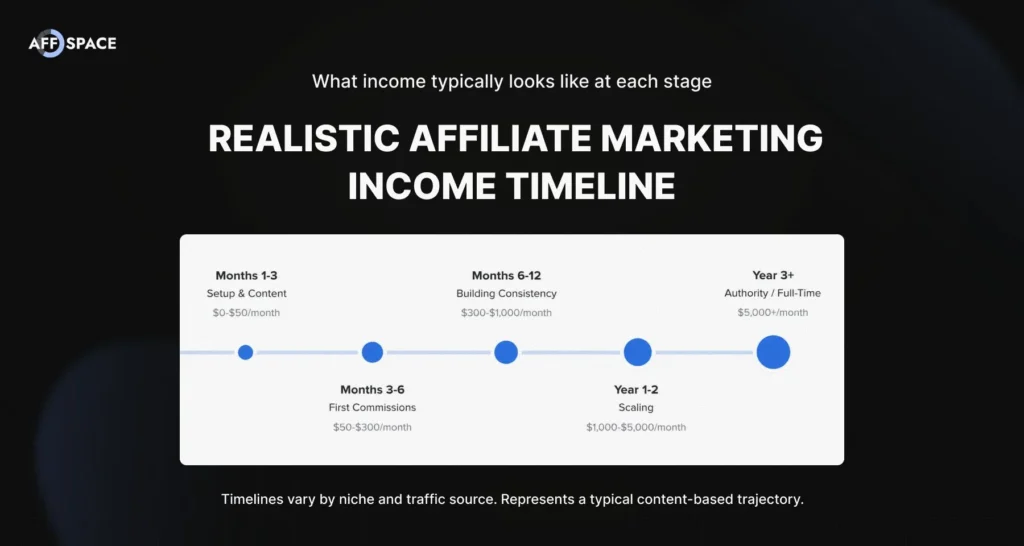
How Long Before You Start Earning? Realistic Timeline
Many newcomers naturally wonder how much beginner affiliates make before reaching more stable monthly income levels.
A realistic timeline for how to become an affiliate marketer often looks like this:
- Months 1–3: Earnings are often close to zero during this phase.
- Months 3–6: First commissions may begin appearing, often in the range of $50–$200 per month.
- Months 6–12: Some affiliates begin reaching more consistent income levels around $500–$1,000 monthly as older content starts generating recurring traffic.
- Years 2–3: Established affiliates with compounding content and stable traffic sources may grow toward $1,000–$5,000+ monthly income.
These timelines vary significantly depending on niche, traffic sources, and content quality, but delayed income growth is a structural characteristic of affiliate marketing. Affiliates who treat the first year as a learning investment rather than a revenue period tend to build more durable operations.
How to Increase Your Affiliate Marketing Income (Without Starting Over)
Growth often depends on improving the performance without rebuilding everything from the ground up.
There are several proven ways affiliates increase income without rebuilding from scratch.
- Move to higher-commission programs. Some affiliate programs simply pay more for the same effort. Switching from a 3% physical-product commission to a 30% recurring SaaS commission on similar traffic can double monthly revenue without a single extra visitor. Evaluating program economics before committing is one of the highest-leverage decisions an affiliate can make.
- Improve CR via better content and link placement. Small improvements in conversion rates can have a major impact on affiliate revenue over time. For example, 10,000 monthly visitors converting at 1% with a $40 commission generate roughly $4,000 in affiliate income. Increasing the conversion rate to 2% doubles that figure without adding any new traffic.
- Add an email list to monetise existing traffic. Email lists allow affiliates to maintain direct access to their audience instead of relying entirely on search engines or social media platforms. They create additional opportunities to promote relevant offers over time. For many affiliates, email lists become one of the most reliable long-term traffic and revenue channels.
- Diversify traffic sources to reduce algorithm dependency. Affiliates who rely entirely on a single traffic source remain highly vulnerable to algorithm updates and platform changes. Losing 50% of search traffic overnight can have an immediate impact on revenue. Diversifying traffic sources helps create a more stable and resilient income stream.
Conclusion
Affiliate marketing income is far less predictable than online success stories often make it seem. Some affiliates earn very little, while others build large-scale businesses over time. The difference usually comes down to many factors, like niche selection or traffic quality.
So, is affiliate marketing profitable in the long run? It can be, but usually for affiliates willing to treat it as a real business and not a shortcut to passive income.
If you’re ready to stop reading about income potential and start building it, joining a program like AFFspace — with 45% RevShare, up to $50 CPA, and a 120-day cookie window — gives you a proven structure to monetise from your first conversion.
